You study for months.
Sometimes years.
Then someone says…
“Lakhs of students write UPSC. Only a few become IAS officers.”
That single sentence scares many aspirants.
Some quit before they even begin.
But here’s the truth.
If you understand how IAS selection actually works, you’ll stop worrying about the numbers and start focusing on what really matters.
Let’s clear the confusion.
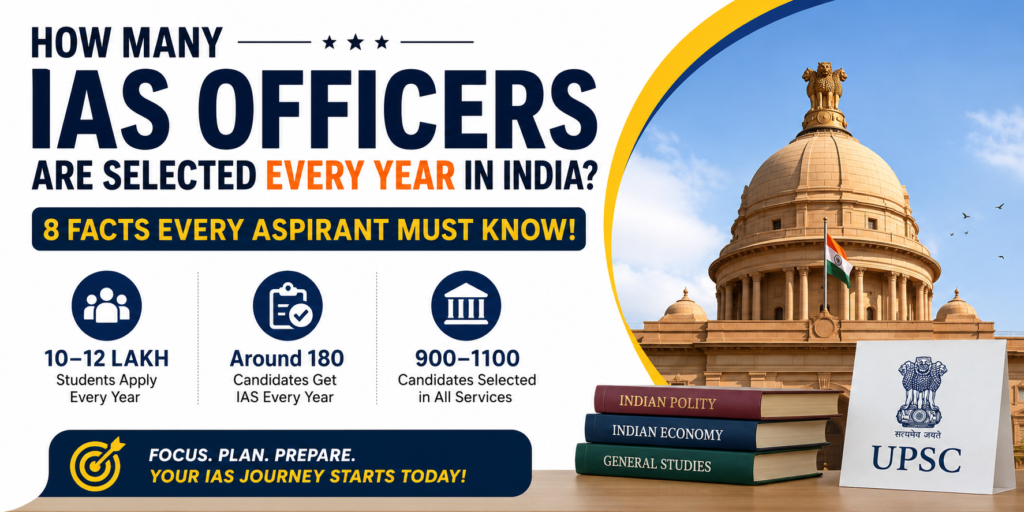
Every year, around 180 to 200 candidates are allocated to the Indian Administrative Service (IAS).
The exact number changes depending on vacancies announced by the Government of India.
For example:
| Year | Approximate IAS Vacancies |
|---|---|
| 2022 | Around 180 |
| 2023 | Around 180 |
| 2024 | Around 180+ |
| 2025 | Varies based on official notification |
The number isn’t fixed.
It depends on retirements, promotions, cadre requirements, and government decisions.
Does UPSC recruit only 180 people?
No.
This is where many aspirants get confused.
UPSC Civil Services Examination recruits officers for more than 20 different services.
These include:
Every year, around 900 to 1100 candidates receive service allocations.
Out of them, only around 180 become IAS officers.
Here’s something that surprises most people.
Approximate numbers are:
At first, these numbers may look scary.
But think about it.
Many applicants don’t prepare seriously.
Many skip attempts.
Some write only to gain experience.
You are not competing against everyone who fills out a form.
You are competing against those who prepare consistently.
That changes everything.

The process has three stages.
This is the screening test.
Only qualified candidates move to Mains.
This is where your rank begins to take shape.
Your writing skills matter.
Your answer presentation matters.
Your consistency matters.
The interview is not about checking your memory.
It evaluates:
Your final rank is based on your Mains marks and Interview marks.
The exact rank changes every year.
It depends on:
Generally:
Every year’s cut-off is different.
That’s why you should aim for the highest possible score instead of targeting the minimum.
Yes.
But not for the reason most people think.
The biggest challenge isn’t the competition.
It’s consistency.
Many aspirants stop after:
Those who stay consistent often move much closer to success than they expected.
Many aspirants spend hours searching:
These questions don’t improve your preparation.
Instead, ask yourself:
That’s what improves your chances.
Wrong.
Many successful IAS officers were average students in school or college.
No.
Candidates clear UPSC in multiple Indian languages every year.
Clear thinking matters more than fancy English.
Not always.
Many candidates succeed through self-study.
Coaching helps with guidance, but your effort decides the result.
If you’re serious about becoming an IAS officer, build these habits early:
Small improvements every week become big results over time.
Many aspirants don’t fail because they lack intelligence.
They fail because they prepare without a clear plan.
A structured strategy can help you:
Good guidance doesn’t guarantee success, but it can save months of confusion and help you prepare more effectively.
Every year, only around 180 candidates become IAS officers.
At first, that number sounds small.
But remember this:
Every one of those officers started exactly where you are now.
With doubts.
Questions.
And uncertainty.
The difference wasn’t luck.
It was consistent preparation, smart planning, and the willingness to keep going when others stopped.
If becoming an IAS officer is your goal, don’t let the numbers discourage you.
Let them remind you that every successful candidate once made the same decision you’re making today—to begin.
Usually around 180 to 200 candidates are allocated to the IAS each year, depending on vacancies announced by the Government of India.
Around 900 to 1100 candidates are selected across different Civil Services, including IAS, IPS, IFS, IRS, and others.
Around 10 to 12 lakh candidates register every year, while approximately 5 to 6 lakh appear for the Preliminary Examination.
Yes. Many successful IAS officers were average students before starting UPSC preparation. Consistency, planning, and regular practice matter more than past academic performance.
No. Coaching can provide guidance and structure, but success depends on your preparation, revision, answer writing, and consistency.
© 2025 Created & Maintained by PM IAS ACADEMY – Unit of Plover Minds Institute LLP