Have you ever seen “IA” in a police-related news report or while preparing for police exams and wondered what it actually means?
You’re not alone.
Many people assume they know the answer. But they often confuse IA with other police terms. That small mistake can cost marks in competitive exams. It can also leave you confused when reading crime news.
Here’s the good news.
In the next few minutes, you’ll understand what IA in police means, where it is used, why it matters, and the different meanings depending on the situation.
Let’s start.
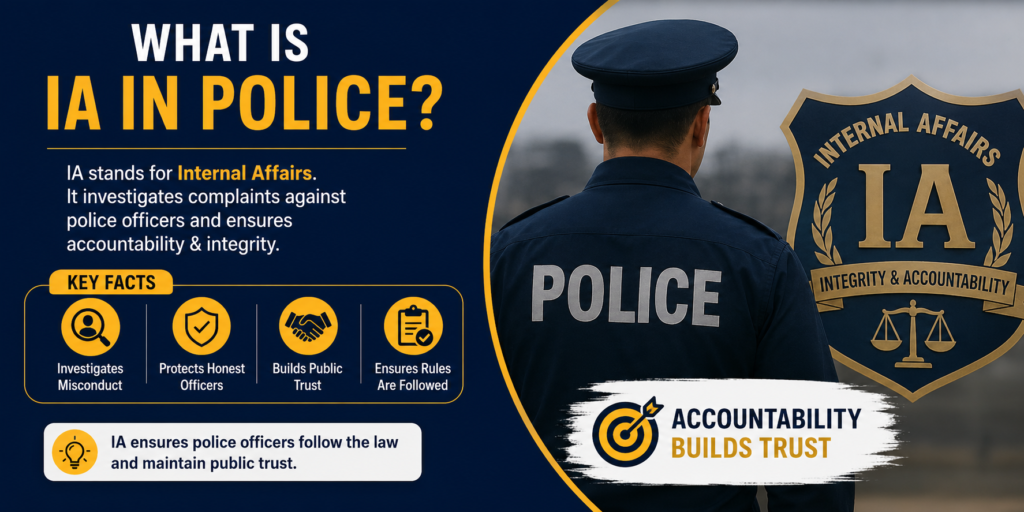
IA usually stands for Internal Affairs in police departments.
The Internal Affairs (IA) Division investigates complaints against police officers. Its job is to make sure officers follow the law, department rules, and ethical standards.
Think of it like this.
Police officers enforce the law for the public.
Internal Affairs makes sure police officers also follow the law.
That is why IA plays a key role in maintaining trust between the police department and the public.
Imagine this.
A police officer is accused of:
Who investigates the officer?
This is where Internal Affairs steps in.
Instead of ignoring complaints, IA investigates them fairly and collects evidence before making recommendations.
Without IA, public trust in law enforcement would quickly decline.
The biggest responsibility of Internal Affairs is investigating complaints against police personnel.
These complaints may come from:
Every complaint is reviewed carefully.

Many people believe IA only punishes officers.
That’s not true.
If an officer is falsely accused, IA can clear their name after conducting a proper investigation.
This protects honest officers from false allegations.
Internal Affairs investigates issues such as:
The goal is accountability.
An IA investigation may include:
The investigation is based on facts—not assumptions.
This is a common misunderstanding.
Being investigated by IA does not automatically mean an officer committed misconduct.
The investigation simply determines what actually happened.
People are more likely to trust the police when complaints are handled fairly.
Internal Affairs helps create transparency and accountability.
That benefits both citizens and responsible officers.
This is where many exam candidates get confused.
Depending on the country or department, IA may refer to different things.
Examples include:
Always understand the context before answering exam questions.
Here’s a simple process.
A complaint is received.
IA reviews the complaint.
Evidence is collected.
Witnesses are interviewed.
The officer’s statement is recorded.
A report is prepared.
Senior officials decide the next action.
This process helps ensure fairness.
If you’re preparing for:
You may come across questions related to police administration.
Understanding IA gives you an advantage.
Many candidates skip these basic administrative terms.
Those who learn them score easy marks.
Answer: Internal Affairs.
Answer: To investigate complaints and misconduct involving police officers.
Answer: No. IA investigates both misconduct and policy violations.
Answer: It promotes accountability, transparency, and public trust.
IA exists only to punish police officers.
Truth: IA also protects officers who are wrongly accused.
Every IA investigation ends in suspension.
Truth: Many investigations conclude without disciplinary action if there is no evidence.
IA works against police officers.
Truth: IA works to maintain professional standards across the department.
| Internal Affairs | Regular Police Investigation |
|---|---|
| Investigates police officers | Investigates crimes committed by the public |
| Focuses on misconduct | Focuses on criminal offences |
| Maintains department integrity | Maintains public safety |
| Reports to senior police leadership | Reports through standard criminal investigation channels |
No.
Different countries may use different names or structures, but the purpose is generally similar.
Yes.
Most police departments allow citizens to submit complaints regarding officer misconduct.
It depends on local laws and departmental policies.
Some IA investigators are sworn police officers with arrest powers.
Yes.
Questions on police administration and ethics often appear in recruitment exams.
If you’ve been searching for “What is IA in police?”, the simple answer is this:
IA usually means Internal Affairs, the department responsible for investigating complaints against police officers and ensuring accountability within the police force.
It’s a term that every police aspirant should know.
More importantly, understanding its purpose helps you appreciate how law enforcement maintains public trust and professional standards.
© 2025 Created & Maintained by PM IAS ACADEMY – Unit of Plover Minds Institute LLP