You cleared UPSC CSE.
Your name is on the final merit list.
You are finally close to the dream you have worked for years to achieve.
But then comes the question that worries almost every UPSC aspirant:
“Which rank is required for IAS?”
And the answer is not as simple as “You need Rank 1.”
In the UPSC Civil Services Examination 2021, the required IAS rank depended on your category and the final service allocation process. Some candidates secured IAS with ranks beyond the Top 100. In fact, the last reported IAS allocation in CSE 2021 went up to AIR 77 for General, AIR 333 for OBC, AIR 320 for EWS, AIR 502 for SC, and AIR 547 for ST.
So, if you are asking which rank is required for IAS 2021, here is the answer you need.
| Category | First IAS Rank | Last IAS Rank |
|---|---|---|
| General | AIR 1 | AIR 77 |
| OBC | AIR 26 | AIR 333 |
| EWS | AIR 93 | AIR 320 |
| SC | AIR 22 | AIR 502 |
| ST | AIR 120 | AIR 547 |
These figures show one important thing:
There is no single IAS cutoff rank for every aspirant.
Your category matters.
The number of vacancies matters.
Your service preferences matter.
And the final allocation process matters.
That is why one candidate may get IAS at a rank that another candidate may not.
Many aspirants think:
“If I do not get a rank under 50, my IAS dream is over.”
That is not always true.
Look at the 2021 data.
A General category candidate needed a much higher rank than an OBC, EWS, SC, or ST candidate in the reported allocation range. This does not mean that you should prepare with a lower target.
And this is where many aspirants make a dangerous mistake.
They prepare for the minimum possible rank.
Instead, you should prepare for the best possible rank.
Why?
Because nobody knows your exact service allocation before the final process is completed.
A small change in vacancies can change the rank required.
A change in category-wise allocation can change the result.
And your service preference also matters.
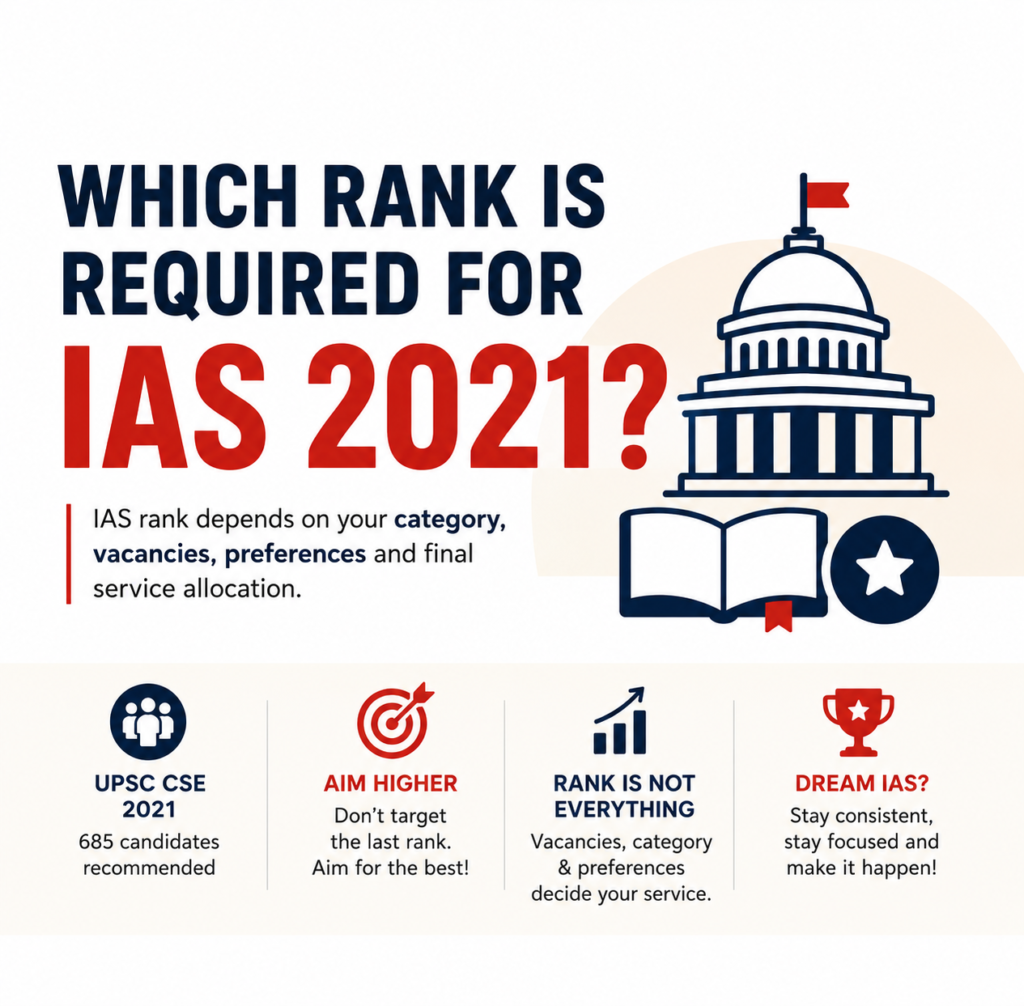
So, if your dream is IAS, don’t prepare to just reach the last possible IAS rank.
Prepare to get the highest rank you can.
For the General category, the reported IAS allocation range in CSE 2021 was:
AIR 1 to AIR 77.
This means that a General category candidate with a rank within this range could be considered for IAS allocation, subject to the allocation process and other conditions.
But here is the part many aspirants miss:
AIR 77 is not a guaranteed target for every future UPSC attempt.
The rank required can change every year.
Why?
Because the number of IAS vacancies changes.
The category-wise distribution changes.
The preferences of candidates change.
And the final allocation process can also affect the outcome.
So, if you are a General category aspirant, targeting only AIR 77 may be risky.
A safer strategy is to aim for the top 50.
The higher your rank, the more choices you usually have.

For OBC candidates, the reported IAS allocation range in CSE 2021 was:
AIR 26 to AIR 333.
This is one of the reasons why category-wise rank comparisons can be confusing.
An OBC candidate with a rank beyond 300 could be allocated IAS in the 2021 cycle, while a General category candidate needed a much higher rank.
But don’t make the mistake of treating this as a permanent rule.
Every year is different.
Your category certificate must also meet the required conditions. Service allocation depends on the rules applicable to that examination cycle.
For EWS candidates, the reported IAS allocation range in 2021 was:
AIR 93 to AIR 320.
Again, this shows why your final rank alone does not tell the complete story.
Two candidates with similar marks may receive different services because of category, preferences, and the number of vacancies available.
For SC candidates, the reported IAS allocation range in CSE 2021 was:
AIR 22 to AIR 502.
This is a wide range.
And it reveals something that many aspirants don’t realize:
You do not necessarily need a Top 100 rank to become an IAS officer.
But this should not make your preparation less serious.
The real goal is still the same:
Get the highest rank possible.
A better rank gives you more service and cadre choices.
For ST candidates, the reported IAS allocation range in CSE 2021 was:
AIR 120 to AIR 547.
This was the reported range for the 2021 allocation data.
However, future aspirants should not assume that the same rank will work every year.
UPSC does not have a permanent fixed rank cutoff for IAS.
The final rank required can move.
This is the question you should really focus on.
The rank required for IAS changes mainly because of:
More vacancies can increase the number of candidates who receive IAS.
Fewer vacancies can make the competition even tighter.
The number of seats available under different categories affects the rank at which IAS allocation may end.
Not every candidate ranked above you will necessarily choose IAS.
Some may prefer IFS.
Some may prefer IPS.
Others may choose different Central Services.
This can affect service allocation.
Your final rank is based on your performance in the written examination and Personality Test.
A good Prelims score alone does not guarantee IAS.
A good Mains score alone does not guarantee IAS.
Your final combined performance matters.
The final service is allocated based on the applicable rules, vacancies, category, merit, and preferences.
That is why simply asking “What is the IAS cutoff rank?” can give you an incomplete answer.
The answer depends on your category and the particular examination year.
For the General category, the 2021 reported last IAS allocation was AIR 77.
So, AIR 100 was not enough for the General category in that reported 2021 allocation range.
But for other categories, the IAS allocation range extended beyond AIR 100.
This is why your preparation target should not be based only on the last selected rank.
A better question is:
“What rank should i target to give myself a strong chance of IAS?”
The answer is simple:
Target the highest rank possible.
If you are a General category aspirant, aiming for the Top 50 gives you a stronger safety margin than preparing only for AIR 77.
For reserved category aspirants, the required rank can vary significantly depending on the category and the year.
It depends entirely on your category and the year.
In the reported 2021 allocation data, IAS allocation extended to:
But the same rank would not have meant the same outcome for every category.
So don’t compare your rank with someone else’s without looking at the complete picture.
A rank is not just a number.
Your category, vacancies, preferences, and service allocation all matter.
The final result of the Civil Services Examination 2021 recommended 685 candidates for appointment to the IAS, IFS, IPS, and Central Services, Group A and Group B. The examination had 749 reported vacancies.
This is an important reality check.
Thousands of candidates compete.
But only a limited number finally receive service allocation.
And among those candidates, the IAS has a limited number of available positions.
That is why even a small improvement in your rank can matter.
A rank of 80 and a rank of 50 may look close on paper.
But in the final allocation process, those 30 ranks can make a major difference.
Don’t ask:
“What is the lowest rank that can get me IAS?”
Ask:
“What is the best rank i can achieve?”
Because the minimum rank changes.
Your target should not.
If IAS is your first preference, build your preparation around a Top Rank mindset.
That means:
The candidates who reach the top usually understand one thing:
Every mark matters.
One extra mark in Mains can improve your rank.
One better answer can change your final score.
One stronger interview can improve your position.
And one rank can change the service you receive.
For the UPSC CSE 2021, the reported IAS allocation range was:
But remember:
These are 2021 figures. They are not a permanent IAS cutoff.
The required rank can change every year based on vacancies, category, candidate preferences, and service allocation.
So if you are preparing for UPSC, don’t chase the last rank that got IAS.
Chase the best rank you can get.
Because the difference between “I almost got IAS” and “I got IAS” can sometimes be just a few marks.
And that is exactly why every test, every answer, and every revision matters.
There is no single fixed minimum rank for IAS. It changes according to category, vacancies, service preferences, and the year of examination.
In the reported UPSC CSE 2021 allocation data, the General category IAS range was AIR 1 to AIR 77.
Yes, depending on your category and the examination year. In the reported 2021 data, IAS allocation extended beyond AIR 100 for OBC, EWS, SC, and ST categories.
It depends on your category and the specific year’s allocation. In the 2021 reported data, IAS allocation extended to AIR 502 for SC and AIR 547 for ST.
No. AIR 1 is not necessary. Many candidates become IAS officers with ranks below AIR 1, depending on the allocation process.
No. Rank is extremely important, but service allocation also depends on factors such as category, vacancies, preferences, and applicable allocation rules.
You should aim for the highest rank possible. A stronger rank gives you a better chance of getting your preferred service and improves your position during allocation.
The real question is not “What is the lowest rank required for IAS?”
It is:
“How high can you take your rank?”
That is the question that can change your result.
© 2025 Created & Maintained by PM IAS ACADEMY – Unit of Plover Minds Institute LLP