You have probably asked yourself this question more than once: Which rank is required for IAS?
Many UPSC aspirants spend years preparing for the Civil Services Examination without fully understanding the rank they need to secure their dream service. Some believe any rank within the top 1,000 is enough. Others assume only the top 50 candidates become IAS officers.
The truth lies somewhere in between.
Your UPSC rank plays a crucial role in determining whether you get the Indian Administrative Service (IAS) or another prestigious service. Understanding the rank requirements can help you set realistic goals and prepare strategically.
So, what rank is actually required for IAS? Let’s break it down.
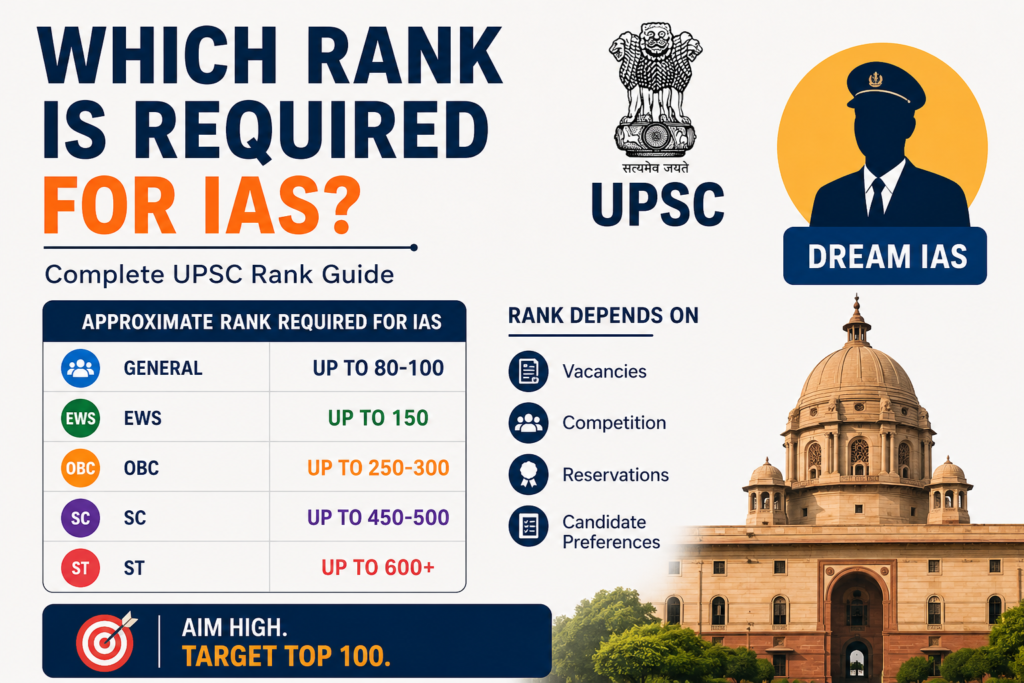
The rank required for IAS depends on several factors:
Generally, candidates securing ranks within the top 80 to 100 in the General category have a strong chance of getting IAS.
However, category reservations can allow candidates from reserved categories to receive IAS with comparatively lower ranks.
| Category | Approximate Rank Required for IAS |
|---|---|
| General | Up to 80-100 |
| EWS | Up to 150 |
| OBC | Up to 250-300 |
| SC | Up to 450-500 |
| ST | Up to 600+ |
These figures vary every year depending on vacancies and cut-offs.
Knowing the attempt limit alone isn’t enough.
You must also meet the age criteria.
Additional relaxations are available according to UPSC guidelines and category eligibility.
Looking at past trends helps set realistic expectations.
| Year | General Category Last IAS Rank (Approx.) |
|---|---|
| 2021 | Around 80 |
| 2022 | Around 90 |
| 2023 | Around 85 |
| 2024 | Around 95 |
These figures fluctuate based on:
The key takeaway?
Aspirants targeting IAS should ideally prepare for a rank within the top 100 if competing in the General category.

This surprises many aspirants.
Imagine two candidates:
You might assume Candidate A automatically gets IAS.
Not always.
Service allocation also depends on:
Candidates submit their preferred services.
If someone chooses IPS above IAS, their allocation can differ.
Reserved category candidates may secure IAS at ranks where General category candidates may not.
Certain services have specific medical standards.
These factors influence final allocation.
More vacancies generally mean a wider rank range for IAS allocation.
Fewer vacancies increase competition.
Every year, lakhs of candidates apply for UPSC.
A small change in performance can significantly affect rank.
Reservation plays a major role in service allocation.
Not everyone chooses IAS as their first preference.
This can slightly affect allocation patterns.
Cut-offs help you qualify.
Ranks determine your service.
Always focus on maximizing marks rather than merely clearing cut-offs.
Understanding historical trends helps set practical targets.
Many candidates perform well in Mains but lose rank due to a weak interview score.
Instead of saying:
“I want to clear UPSC.”
Say:
“I want a rank within the top 100.”
Specific goals improve preparation quality.
Prepare for top scores, not just qualification.
Your optional subject can significantly influence your final rank.
Choose based on:
UPSC rewards clarity, structure, and analysis.
Daily answer writing can create a huge difference in rank.
Interview marks often become the deciding factor between IAS and other services.
Studying successful candidates helps identify what UPSC values.
Yes, candidates from reserved categories may receive IAS around this rank. For General category candidates, the chances are usually lower.
In many years, yes. A rank around 100 often remains competitive for IAS allocation.
For General category aspirants, a rank below 80 to 100 is generally considered safe.
Yes. Category reservation significantly impacts IAS allocation ranks.
Yes. Cut-offs only determine qualification. Final rank determines service allocation.
If you are wondering which rank is required for IAS, the simple answer is that it depends on your category, vacancies, and yearly competition. However, General category candidates should ideally target a rank within the top 100, while reserved category candidates may secure IAS at comparatively lower ranks.
The most important lesson is this: don’t prepare merely to clear UPSC. Prepare to secure a rank that gives you the service you truly want.
© 2025 Created & Maintained by PM IAS ACADEMY – Unit of Plover Minds Institute LLP