If you’re preparing for UPSC or Judiciary exams, you’ve probably asked this question at least once.
Who is more powerful? An IAS officer or a Judge?
Maybe you’ve seen debates on YouTube. Maybe your friends gave different answers. Or maybe you’re choosing between UPSC Civil Services and Judicial Services.
Here’s the problem.
Most answers on the internet only compare salary, status, or government perks. They don’t explain how power actually works in India.
By the end of this article, you’ll know:
Let’s clear the confusion.
Before comparing an IAS officer and a judge, you need to understand one thing.
Power isn’t just about official cars, security, or respect.
Real power includes:
Once you understand this, the comparison becomes much easier.
There isn’t one winner.
An IAS officer and a judge have different powers.
Neither works under the other in their official role.
Instead, they are part of different pillars of democracy.
An IAS officer belongs to the Executive.
Their job is to make sure government policies reach people.
They handle:
If a flood hits a district at midnight, it is usually the District Collector who coordinates the response.
That is real administrative power.
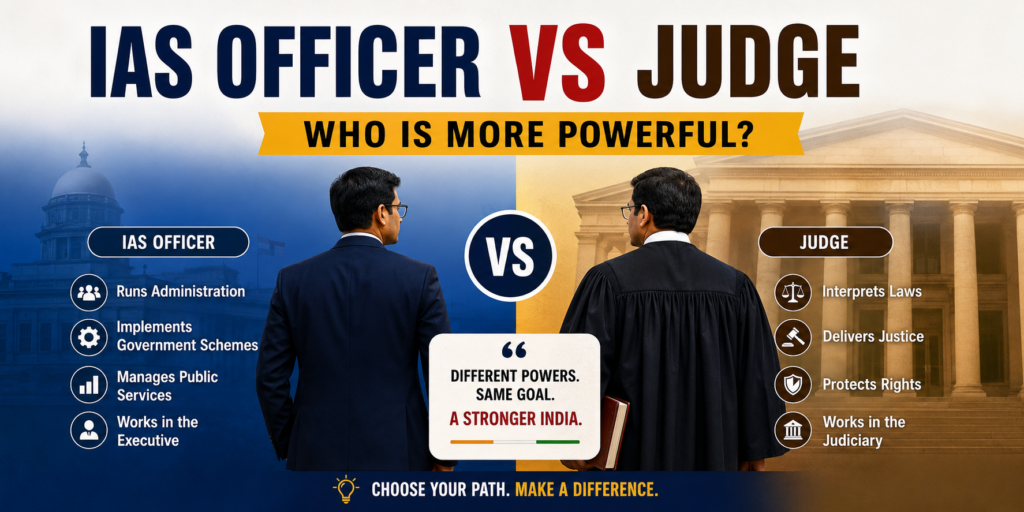

A judge belongs to the Judiciary.
Their role is different.
A judge decides:
A judge doesn’t implement schemes.
Instead, a judge checks whether actions taken by the government follow the Constitution and the law.
Yes.
If an IAS officer issues an order that violates the law or the Constitution, a court can cancel it.
This is one of the biggest checks and balances in Indian democracy.
This doesn’t mean the judge controls the IAS officer.
It means every government authority must act within the law.
No.
An IAS officer cannot cancel or change a court judgment.
If the government disagrees with a court order, it must challenge it in a higher court.
This protects judicial independence.
The IAS officer.
Every day, IAS officers take decisions affecting thousands or even millions of people.
Examples include:
Their decisions directly affect public administration.
The judge.
A court can:
This legal authority is unique.
No administrative officer has this power.
Usually, the IAS officer.
Collectors, Commissioners, Secretaries, and Chief Secretaries often appear in news because they manage public issues.
Judges usually work inside courtrooms.
Their influence comes through judgments, not public appearances.
Both have excellent careers.
Both careers carry immense responsibility.
Salary is not the biggest difference.
Both receive:
The real difference lies in the nature of work, not income.
This depends on whom you ask.
Some admire IAS officers because they solve public problems.
Others admire judges because they protect justice and constitutional values.
Both enjoy high respect in society.
Ask yourself these questions.
Do you enjoy:
Then IAS may suit you.
Or do you enjoy:
Then the Judiciary may be a better fit.
Don’t choose based only on “power.”
Choose based on the work you’ll enjoy for decades.
| Feature | IAS Officer | Judge |
|---|---|---|
| Main Role | Administration | Justice |
| Service | Executive | Judiciary |
| Makes Policy Decisions | Yes | No |
| Interprets Law | No | Yes |
| Implements Government Schemes | Yes | No |
| Can Cancel Illegal Orders | No | Yes |
| Works With Public Daily | Yes | Limited |
| Protects Constitutional Rights | Indirectly | Directly |
Many people think an IAS officer is “above” a judge.
Others think a judge controls every government officer.
Neither is true.
India follows the principle of separation of powers.
The Executive governs.
The Judiciary interprets the law.
Each keeps the other accountable.
That’s what makes democracy stronger.
So, who is more powerful?
The honest answer is this:
An IAS officer has greater administrative power.
A judge has greater judicial authority.
These powers are different, not competing.
If your dream is to lead districts, shape public policy, and solve people’s everyday problems, IAS is the right path.
If your goal is to uphold justice, protect constitutional values, and make decisions based on law, becoming a judge may be the better choice.
The best career isn’t the one with the most power.
It’s the one that matches your purpose.
Thousands of aspirants begin their UPSC journey every year. Many quit because they don’t have the right guidance, strategy, or mentorship.
You don’t need to repeat their mistakes.
If you’re serious about becoming an IAS officer, start with a structured preparation plan, experienced mentors, regular mock tests, and answer-writing practice from day one.
The earlier you build the right foundation, the stronger your chances of clearing the UPSC Civil Services Examination.
What do you think?
Do you believe an IAS officer is more powerful, or does a judge hold greater authority? Share your opinion in the comments. We’d love to hear your perspective.
© 2025 Created & Maintained by PM IAS ACADEMY – Unit of Plover Minds Institute LLP