You want to become an IAS officer.
But right now one question keeps bothering you.
“Which degree should I choose after 12th?”
Everyone gives different advice.
Parents say one thing. Teachers say another. Friends follow trends.
And you don’t want to make a mistake that costs years.
Here’s the truth most people won’t tell you:
No degree guarantees IAS. But the wrong one can make your journey harder.
This guide will help you choose wisely — based on what actually works in UPSC preparation.
UPSC doesn’t care about your degree name.
It cares about:
So the real question is not:
“Which degree is best?”
The real question is:
“Which degree helps YOU prepare for UPSC easily while staying motivated for 3–5 years?”
If you ignore this, you’ll struggle later.

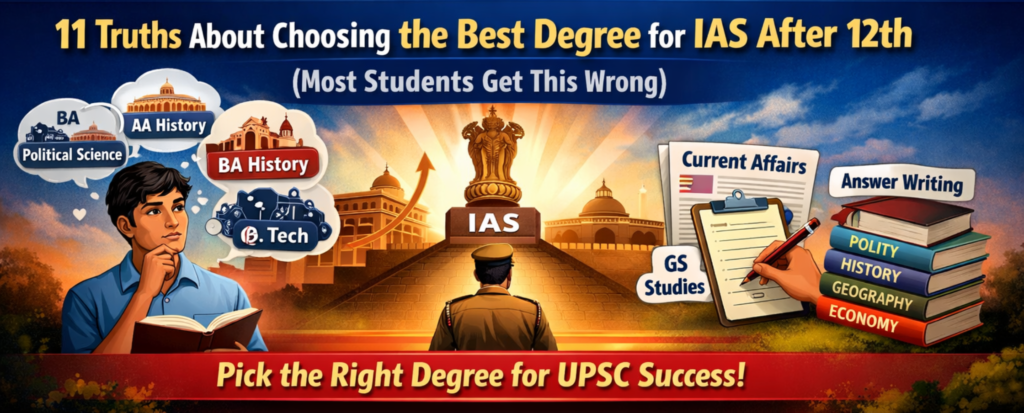
BA in Political Science is the most aligned degree for UPSC preparation because it directly covers key areas like the Indian Constitution, governance, international relations, and political theory—topics that appear in Prelims, Mains, and the interview.
It allows students to prepare for college exams and UPSC simultaneously, offers relatively lower academic pressure, and builds a strong foundation for General Studies.
However, many students become complacent due to this flexibility and later regret not using the time effectively.
History is widely covered in UPSC: Ancient, Medieval, Modern, Art & Culture
Strong overlap with Prelims and Mains syllabus
Improves answer writing and supports essay paper
Works well if you enjoy stories, events, and timelines
Builds conceptual clarity for GS preparation
Catch:
Requires consistent reading habit
Can feel boring if you’re not genuinely interested
Connects science with society, making it practical and analytical
Covers environment, climate, mapping, and disaster management
Useful for Prelims, Mains GS, and Geography optional
Helps in understanding current affairs like climate change and natural disasters
Considered a scoring optional by many aspirants and toppers
But:
Requires strong conceptual clarity
Not effective if studied through rote memorization alone
Easy to understand and closely linked to real-life issues
Many aspirants shift to Sociology optional during preparation
Helps in Essay, Ethics, and GS answers with practical examples
Covers society, inequality, social change, and human behavior
Improves analytical thinking and clarity of expression
Why it works:
UPSC rewards clear, relatable, and well-structured answers
Sociology helps present concepts in a simple, impactful way
Builds strong analytical and decision-making skills
Helps understand budget, inflation, economic policies, and governance
Useful for Prelims, Mains GS, and current affairs analysis
Strengthens answer quality with data-driven arguments
But:
Requires comfort with basic math, graphs, and logical reasoning
Can feel stressful if you dislike numbers or economic concepts
Many UPSC toppers come from engineering backgrounds
Builds a strong problem-solving mindset and analytical thinking
Develops discipline, consistency, and structured preparation habits
Provides a solid backup career option if plans change
Reality check:
Engineering demands significant time and academic effort
Balancing college workload with UPSC preparation is challenging
Requires clear planning, time management, and long-term consistency
Doctors do clear UPSC, but the path is demanding
Heavy syllabus, clinical training, and long study hours
Very limited time left for consistent UPSC preparation
Best approach:
Choose MBBS only if you genuinely want a career in medicine
Not as a backup or “safe” degree for UPSC preparation
Builds understanding of finance, management, and business environment
Useful for governance, public administration, and policy-related thinking
Helps develop decision-making and organizational skills relevant to administration
But:
Limited direct overlap with the UPSC syllabus
Requires separate, dedicated preparation for GS subjects

Here’s the honest answer.
There is no single best degree.
There is only:
Best degree for YOU.
Ask yourself:
Your answer decides your degree.
Not trends.
Not relatives.
Not social media.
They choose degree first.
UPSC later.
Then they realize:
And they waste 2–3 years adjusting.
You don’t want this.
They align 3 things early:
This saves:
And builds confidence.
Start simple.
Pick a degree that:
For most students, these work best:
Not because they are “easy.”
Because they align with the exam.
A student prepared for UPSC after engineering.
He spent 2 years just understanding basics:
Another student studied political science in college.
She started writing answers from first year.
Guess who got confidence faster?
Right degree reduces friction.
That matters more than intelligence.
Your:
UPSC is not a knowledge test.
It’s a patience test.
Before selecting a degree, decide:
If serious, plan from now.
Not after graduation.
Because early starters always have an advantage.
© 2025 Created & Maintained by PM IAS ACADEMY – Unit of Plover Minds Institute LLP