You’ve probably heard this question again and again.
Which is more powerful — IAS or IPS?
Maybe you’re preparing for UPSC.
Maybe your parents keep asking.
Or maybe you just don’t want to make the wrong choice and regret it later.
Because this decision isn’t small.
It decides your authority, your lifestyle, your stress, your influence, and the kind of respect you get every single day.
And here’s the truth most people don’t tell you…
Power isn’t just about rank.
It’s about where you stand when real problems happen.
Let’s break this clearly.
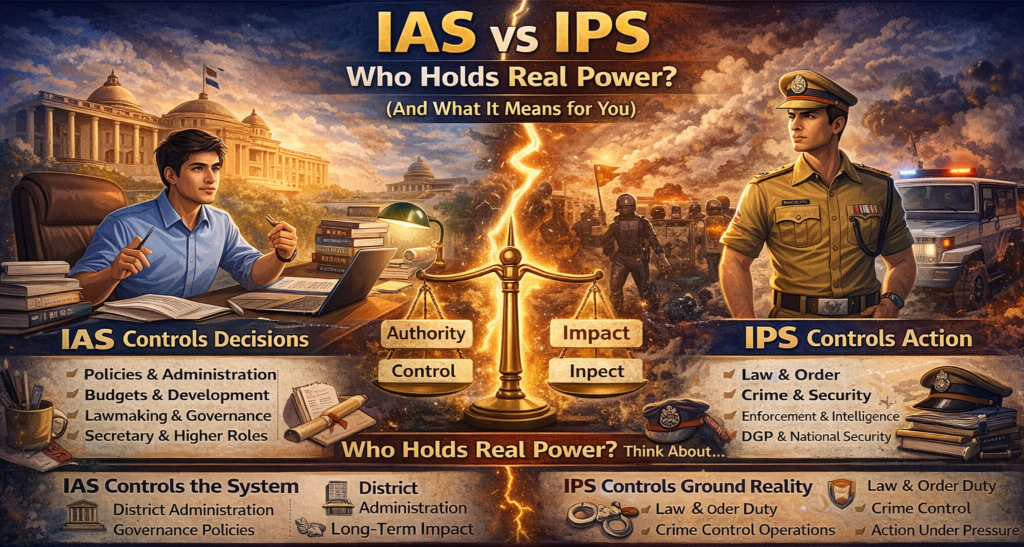
People say IAS is powerful. Others say IPS controls the system.
Both are right. And both are wrong.
Power comes from 3 things:
And this is where the IAS vs IPS debate actually begins

If you become an IAS officer, you sit at the decision table.
You handle:
If you become an IPS officer, you control enforcement.
You handle:
Simple truth:
IAS writes the order.
IPS makes it happen.
Now ask yourself — which feels more powerful to you?
IAS officers often become District Collectors.
That means:
Every major district decision flows through you.
You influence education, health, infrastructure, welfare.
You’re not limited to one system.
You run the whole district.
That kind of control builds long-term authority.
IPS officers command the police force.
When something serious happens:
You take immediate action.
You don’t wait for files.
You act.
And people see that power instantly.
Uniform brings visibility.
Authority is visible every day.
That creates fear, respect, and pressure — all at once.
IAS officers work with policies, governance, and administration.
IPS officers deal with:
One designs systems.
The other handles chaos.
Both are powerful. But the pressure is different.
Early career:
Later career:
IAS can become:
IPS can become:
At higher levels, IAS often influences governance direction.
IPS influences national safety and internal security.
Different arenas. Same weight.
IAS earns respect through authority and governance.
IPS earns respect through courage and control.
One builds systems.
One protects them.
Public perception matters here.
In rural areas, the Collector feels like the most powerful person.
In crime-prone areas, SP feels unstoppable.
Context changes power.
Everyone asks:
Which is more powerful?
But the real question is:
Which pressure can you handle for 30 years?
IAS life:
IPS life:
Power without fit becomes stress.
And stress breaks careers.
Here’s the honest answer.
IAS holds structural power.
IPS holds operational power.
IAS influences the system.
IPS controls the ground.
IAS shapes governance.
IPS controls order.
Neither is “above” the other.
They work together.
But if your goal is:
Then your answer becomes clear.
Many aspirants choose based on status.
Or what relatives say.
Or what looks powerful on social media.
That’s risky.
Because once you enter the service, there’s no reset button.
Ask yourself:
Your personality decides your success.
Not just the rank.
People spend years preparing.
But they never study the life after selection.
And then reality hits.
That’s where confusion starts.
Regret starts.
Comparison starts.
You don’t want that.
Start by understanding:
Talk to officers.
Read case stories.
Study real district situations.
Don’t choose blindly.
Because this isn’t just about power.
It’s about the life you’ll live every day.
What do you think feels more aligned with you right now — administration or enforcement?
Say IAS or IPS.
And also say why.
That “why” usually reveals your real direction.
© 2025 Created & Maintained by PM IAS ACADEMY – Unit of Plover Minds Institute LLP