Most students waste 3 critical years doing the wrong things. Here’s what the top 0.1% do differently.
“I wish someone had told me this in 10th grade. I wasted two years preparing in the wrong direction.”
— Every UPSC aspirant who failed their first attempt
Here’s a question. You’re in 10th grade. You’ve heard about the IAS. It sounds like the most powerful, most respected job in India. And somewhere inside, you think — I can do this.
But you have no idea where to start. Google gives you 50 different answers. Your teachers say “focus on boards first.” And that one uncle at every family gathering says “IAS is too hard, try engineering.”
So what do you actually do?
This guide is for you. Not for someone who’s already in college. Not for someone who’s finished graduation. For you — right now, in or after 10th grade — with years ahead to build the right foundation.
Let’s get into it.
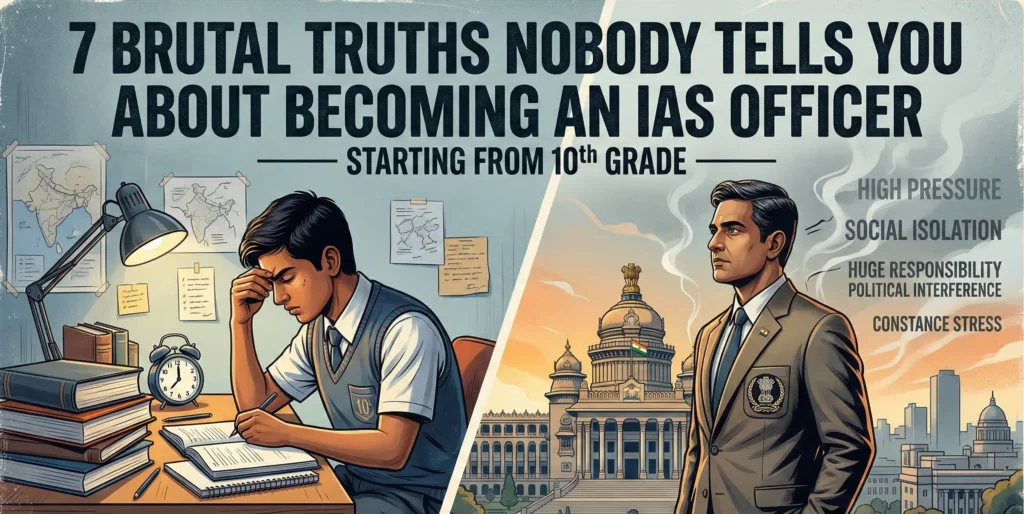
First, let’s clear up the one thing that confuses everyone.
You cannot write the UPSC Civil Services Examination directly after 10th grade. The minimum eligibility is a graduation degree from a recognised university. That’s non-negotiable.
But here’s what’s also true: the students who crack IAS in their first or second attempt almost always started building the foundation years before graduation.
Think of it like fitness. You can’t run a marathon tomorrow just because you decided to today. But if you start training now — slowly, consistently — the marathon becomes possible. This is exactly how IAS preparation works.
What you do between 10th grade and your graduation attempt is the difference between struggling for 5 attempts and clearing it in 1 or 2.

This is where most students make their first big mistake. They pick a stream in 11th grade based on what their parents want, what their marks “allow,” or what their friends are doing. Then 4 years later, they wonder why UPSC feels so hard.
Here’s the deal: UPSC doesn’t require any specific stream. You can be from Science, Commerce, or Arts and still become an IAS officer. Many toppers studied Engineering. Many studied History. It genuinely doesn’t matter.
What matters is this: you will have to choose an Optional Subject for UPSC Mains. And that optional subject contributes significantly to your final score. Students who choose a graduation stream that aligns with their optional subject have a real advantage.
Here’s exactly how the journey looks. Not the vague “study hard and work smart” version. The actual stage-by-stage path.
“The students who crack IAS aren’t smarter than you. They just started earlier and stayed consistent longer.”
Every topper has a version of this list. Here’s the honest one — no fluff, no inspiration-poster nonsense.
Most students study for IAS without fully understanding what the exam actually tests. That’s like training for a cricket match without knowing the rules. Here’s the structure:
Stage 1 — Preliminary Examination (Prelims)
Two objective papers: GS Paper 1 (100 questions, 200 marks) and CSAT Paper 2 (80 questions, 200 marks, qualifying only). Tests breadth — history, geography, science, current affairs, basic maths and logic. Negative marking applies.
Stage 2 — Main Examination (Mains)
Nine papers including Essay, 4 General Studies papers, 2 Optional papers, and 2 language papers. Tests depth and the ability to write well-structured, analytical answers. This is where IAS is actually won or lost.
Stage 3 — Personality Test (Interview)
A 30-minute conversation with a board. Tests your personality, awareness, and decision-making ability. Worth 275 marks. Your DAF (Detailed Application Form) is the base — they ask about your background, hobbies, and opinions on current issues.
“Spending 90% of their time on Prelims and treating Mains as secondary. But Prelims is just the entry gate. Mains determines your rank. The students who start writing practice early — even in graduation — are the ones who eventually top the list.”
You don’t need coaching yet. You don’t need expensive books yet. Here’s exactly what you can do right now, for free, that will give you a real head start.
Start reading a newspaper. Pick one — The Hindu or Indian Express. Read the front page and the editorial. Even 15 minutes counts. Do this every single day. By the time you appear for UPSC, this habit alone will have compounded into thousands of hours of current affairs knowledge.
Read your NCERT textbooks properly. Not for marks — for understanding. History Class 8, 9, 10. Geography Class 9, 10. Political Science Class 9, 10. These are the building blocks of every IAS question on these subjects.
Watch good YouTube content on civics and current affairs. Channels that explain government decisions, Supreme Court judgements, and economic policies in plain language are excellent supplementary tools. Don’t binge — watch 2–3 videos a week with intent.
Start observing India with curiosity. Why does the government announce certain policies? What does “GDP growth” actually mean for ordinary people? Why do elections matter? This curious, questioning mindset is what IAS officers need. And you can start building it today.
You’ve read this far. That already puts you in a different category from most people your age.
But here’s the hardest truth of all: knowledge is not the bottleneck for most IAS failures. Consistency is.
The competition is full of intelligent people. People with better memory than you, faster reading speed than you, better coaching than you. And yet, year after year, students from unremarkable backgrounds crack this exam on their first or second attempt — while many “brilliant” students are on their fifth attempt wondering what went wrong.
The difference is almost always this: how consistently did you show up, for how many years, without losing focus?
One hour of reading every day, for 5 years, beats 10 hours of studying in a panic before the exam. Every time.
You’re in 10th grade. You have time. Use it slowly, deliberately, and consistently. And you will be ready when it counts.
© 2025 Created & Maintained by PM IAS ACADEMY – Unit of Plover Minds Institute LLP