You’ve probably heard this a hundred times: “Get into a top college, and your IAS dream will be easier.” And you’ve probably wondered — is that actually true, or is it just something people say?
Here’s the real answer: your college matters. But not in the way most people think.
The name on your degree certificate won’t crack UPSC for you. What matters is what the college gives you access to — the culture, the library, the optional subject choices, the peer group, and most importantly, the time.
This guide breaks it all down. No fluff. No sponsored college lists. Just what actually works, based on patterns from hundreds of successful IAS toppers.
Let’s get something straight first.
UPSC doesn’t care about your college name. Your marksheet won’t even be asked during the personality test. The interview board won’t give you extra marks because you went to Delhi University or St. Stephen’s.
So why does this question — “which college is best for IAS?” — get asked so often? Because the pattern is real.
When you look at the AIR 1 to AIR 100 rankers over the last decade, a few institutions keep appearing again and again. Not because their name helped — but because of what those environments offered.
“The best college for IAS is not the one with the best rank. It’s the one that gives you time, resources, and a peer group that pushes you to think deeper.”
Pattern seen across 200+ IAS toppers studied
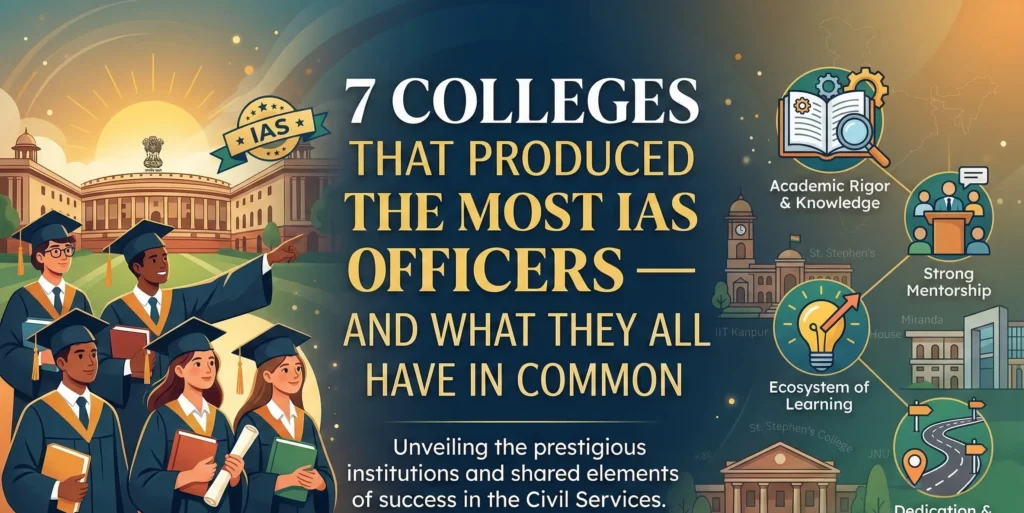
These aren’t random. Every college on this list appears repeatedly in the alma mater sections of civil services toppers. Here’s what each one offers — and what it doesn’t.

“The oldest name on this list — and still one of the most effective.”
This is where the pattern is most obvious. Decades of civil services culture, a fiercely competitive peer group, and proximity to Delhi’s coaching ecosystem. The humanities departments — History, Political Science, Economics — are structured in a way that naturally overlaps with UPSC’s GS papers.
What no one tells you: the real advantage here isn’t the classroom. It’s the seniors. You’re likely to find third-year students who cleared Prelims, or alumni who are posted IAS officers. That kind of mentorship doesn’t have a price.
“More accessible than Stephen’s, and arguably better for self-directed preparation.”
Hindu College gives you something Stephen’s sometimes doesn’t — breathing room. The culture here tends to be slightly less cutthroat academically, which means serious UPSC aspirants can focus their energy on preparation rather than college assignments.
Economics, Political Science, and History departments are strong. The library system is decent, and Delhi’s UPSC coaching belt (Old Rajinder Nagar, Mukherjee Nagar) is a short Metro ride away.
“The south India answer to Stephen’s — and it punches above its weight consistently.”
Year after year, Loyola students appear on the IAS merit list. The Economics and History departments have strong reputations. Tamil Nadu UPSC preparation culture is serious, and being in this environment naturally aligns your mindset.
One underrated advantage: TNPSC (Tamil Nadu Public Service Commission) preparation runs parallel, which keeps a large fraction of your peer group in study mode year-round. That culture is contagious in the best way.
“If you’re serious about History or Political Science as an optional, this is hard to beat.”
Presidency has a legacy of producing serious thinkers. The History optional is considered one of the highest-scoring subjects in UPSC Mains, and Presidency’s department covers most of the syllabus in an academically rigorous way.
The campus environment encourages debate and political thinking — both valuable for the essay paper and the interview round. A number of recent toppers have credited Presidency’s library and faculty guidance as instrumental.
“Don’t underestimate this path — engineers are cracking UPSC at record rates.”
This might surprise you. But if you look at the last 10 AIR 1s, a significant number came from engineering or technical backgrounds. Why? Because UPSC rewards analytical clarity — and technical training builds exactly that.
Science and Technology is a GS paper topic. Maths and Public Administration are popular optionals among engineers. And IIT/IIM peer pressure, channeled toward UPSC, creates an intense but effective preparation environment. The caveat: you’ll need to build up humanities knowledge from scratch. That takes an extra 6–12 months.
“Possibly the best single campus in India for building UPSC-relevant thinking.”
JNU’s International Studies, Political Science, Economics, and History departments are consistently top-ranked. More importantly, debate culture here runs 24/7 — in canteens, corridors, and classrooms. That kind of intellectual sparring sharpens your answer-writing ability and interview performance.
Students here tend to develop strong opinions backed by reading — which is exactly what UPSC’s essay paper and interview stage rewards. The campus library is exceptional.
“Pune’s civil services culture is real, and Fergusson is at the center of it.”
Maharashtra has a strong tradition of civil services aspirants, and Fergusson College sits in the middle of Pune’s UPSC preparation ecosystem. The college’s arts departments — History, Political Science, Economics — provide solid subject foundations.
Pune also has one of India’s better UPSC coaching ecosystems outside Delhi, making it a strong base for aspirants from western and central India.
Before you spend lakhs on a college just because it “sounds right” for IAS — read this section. It might save you a lot of regret.
Your optional subject for UPSC Mains is worth 500 marks — and it can make or break your rank. The smartest move is to choose a college where your graduation subject matches a high-scoring UPSC optional.
History, Political Science, Geography, Economics, Public Administration, Sociology — these are the big ones. If your college has a strong department in any of these, your optional subject preparation is essentially integrated into your degree. That’s a massive time advantage.
This is underrated and almost nobody talks about it. UPSC preparation needs 6–8 hours of self-study daily. If your college has 70% attendance requirements, heavy assignments, and strict internal assessment — you’re losing 3–4 hours a day that a peer at a more relaxed college isn’t losing.
Some of the best IAS selections come from correspondence or open university streams precisely for this reason. Don’t be ashamed of choosing a college partly for its flexibility.
You become who you study with. If your entire social circle is preparing for CA, MBA entrance, or placements — your IAS preparation will be silently de-prioritized. You’ll feel like the odd one out. That’s a psychological drain.
A college where 10–20% of students are UPSC aspirants changes the social math entirely. Conversations, revision groups, mock interview practice — all of it happens organically.
UPSC is fundamentally a reading examination. The better your library access, the lower your coaching costs. Colleges with subscriptions to EPW (Economic and Political Weekly), good newspaper archives, and a range of reference books give you an edge that can’t be measured in coaching hours.
Delhi, Pune, Hyderabad, and Chennai have the deepest UPSC coaching ecosystems in India. Proximity to good test series, interview guidance, group study options, and experienced mentors compounds over 3–5 years of preparation. A college in one of these cities, all else equal, is a better choice than an equally good college in a city with minimal UPSC culture.
Here’s exactly what to do, regardless of which college you’re in or aiming for.
Pick a college that scores high on: optional subject alignment + time freedom + peer culture. From the list above, JNU, Hindu College, and Loyola are the most accessible combinations. Apply aggressively to Delhi University if you can relocate — the ecosystem advantage is real.
Stop waiting for the “right” college. Work with what you have. Start reading The Hindu daily from today. Map your graduation subject to a UPSC optional. Join or form a study group with other UPSC aspirants. Visit Old Rajinder Nagar in Delhi or your city’s UPSC coaching belt — just to feel the environment once.
Your college is no longer the variable. Your preparation strategy is. Focus on building your optional subject depth, consistent newspaper reading, and answer writing practice. The exam doesn’t know where you went to college.
“The IAS exam is the ultimate meritocracy. Your rank depends on how you prepare — not on which college’s hostel you slept in.”
The honest answer: the best college for IAS is the one where you’ll prepare the most effectively.
If you can get into JNU or St. Stephen’s — go. The peer culture and optional subject coverage will give you a genuine edge.
But if you’re in a state university in Indore, Nagpur, or Kochi — don’t spend the next year mourning a missed DU seat. Hundreds of IAS officers came from exactly where you are.
The variable that explains IAS success more than anything else is hours of deliberate, consistent preparation. Your college is the container. What you put into it is entirely your decision.
Now stop reading about which college is best and start reading the UPSC syllabus. That’s the only document that actually matters.
© 2025 Created & Maintained by PM IAS ACADEMY – Unit of Plover Minds Institute LLP