If you’re preparing for UPSC or thinking about becoming an IAS officer, this question matters more than you think:
How many IAS officers are actually working in Andhra Pradesh right now?
Here’s the short answer first:
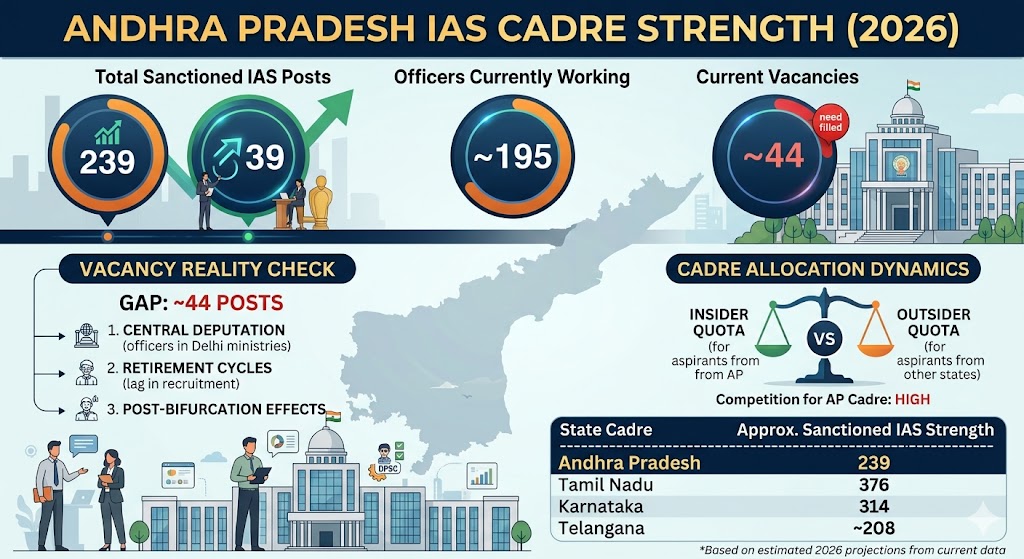
And yes, that gap between 239 vs 195 tells a bigger story. It affects your chances, your competition, and your future posting possibilities.
Let’s break this down clearly.
If you are serious about UPSC, this is not just data.
It tells you:
Many aspirants skip this. And later they regret not understanding cadre strength early.
Here is the real situation right now:
| Category | Number |
|---|---|
| Sanctioned IAS posts | 239 |
| Officers working | ~195 |
| Vacant posts | ~44 |
So yes. Around 44 posts are not filled.
This shortage creates pressure inside administration. But for you, it also signals opportunity.
You may think IAS officers only become District Collectors.
Not true.
These officers handle:
One officer can influence lakhs of people.
That’s the scale you’re preparing for.

This surprises many aspirants.
Here’s why the number is lower than 239:
They work with ministries in Delhi.
So they are counted in cadre strength but not present in the state.
Cadre reviews happen periodically.
Recruitment doesn’t instantly fill gaps.
After the Andhra–Telangana split, cadre restructuring changed deployment patterns.
And that impact still shows today.
Here is the truth most coaching centres don’t explain clearly.
Getting Andhra Pradesh cadre depends on:
But fewer working officers means the state needs administrative strength.
That matters during cadre allocation cycles.
Andhra Pradesh currently has 26 districts.
Each district usually has:
So district-level leadership alone needs around 50+ IAS officers.
Now imagine the total state administration.
You can see why 195 officers is not a large number.
Short answer: yes.
Many aspirants from Andhra Pradesh choose their home cadre.
Why?
Because:
So insider quota competition becomes intense.
But here’s the interesting part.
Every year allocation patterns shift slightly.
And smart aspirants track them.
Most don’t.
Think about this.
Out of lakhs of UPSC aspirants:
only a few hundred become IAS officers each year
and only a small fraction enter one specific cadre
like Andhra Pradesh.
So when you say:
“I want AP cadre IAS”
You are aiming at one of the narrowest funnels in India.
And that’s okay.
But you should prepare strategically.
If you’re serious, use this data like this:
It shows probability shifts.
Helps realistic expectation planning.
Example:
Many aspirants never do this comparison.
You should.
Approximate sanctioned IAS strength:
| State | IAS Posts |
|---|---|
| Andhra Pradesh | 239 |
| Telangana | ~208 |
| Tamil Nadu | 376 |
| Karnataka | 314 |
So AP is mid-sized, not small.
That affects allocation dynamics.
Most aspirants focus only on:
syllabus
books
mock tests
But serious candidates also track:
cadre data
vacancy trends
service structure
Because information reduces uncertainty.
And uncertainty kills consistency.
They prepare for years without clarity on:
Later they feel stuck.
You don’t need to repeat that mistake.
Here’s what you can do right now:
Most aspirants skip step 1 itself.
That’s where clarity begins.
© 2025 Created & Maintained by PM IAS ACADEMY – Unit of Plover Minds Institute LLP