Every year, lakhs of students dream of becoming an IAS officer.
But most of them get stuck on one question:
“What exactly should I study to become an IAS officer?”
Maybe you’re asking the same thing.
You see toppers from different backgrounds. One studied engineering. Another studied history. Someone else came from medicine. That makes the path look confusing.
So what’s the truth?
The truth is that becoming an IAS officer is not about choosing a “special IAS degree.” It’s about studying the right subjects, building the right knowledge, and preparing in the right way.
And here’s something many beginners don’t realize until it’s too late:
Many students spend months studying the wrong things.
This guide will show you exactly what to study, what matters most, and how you can build a strong foundation for UPSC without wasting time.
No.
You can become an IAS officer with any bachelor’s degree from a recognized university.
Students from engineering, commerce, arts, science, medicine, law, and management backgrounds clear UPSC every year.
Your degree does not decide your success.
Your preparation does.
That’s good news because it means you don’t have to change your career plans just to prepare for UPSC.
Instead, focus on building knowledge in the subjects that UPSC actually tests.
No.
You can become an IAS officer with any bachelor’s degree from a recognized university.
Students from engineering, commerce, arts, science, medicine, law, and management backgrounds clear UPSC every year.
Your degree does not decide your success.
Your preparation does.
That’s good news because it means you don’t have to change your career plans just to prepare for UPSC.
Instead, focus on building knowledge in the subjects that UPSC actually tests.
If there is one subject you cannot ignore, it’s Indian Polity.
Questions from the Constitution, Parliament, President, Prime Minister, Fundamental Rights, and governance appear regularly in UPSC exams.
When you understand how India is governed, many current affairs topics also become easier to understand.
A strong grip on Polity helps in Prelims, Mains, and even the Interview.

History is more important than many students think.
UPSC frequently asks questions from Ancient India, Medieval India, and Modern India.
But Modern Indian History deserves extra attention.
Topics like the freedom struggle, social reforms, and important movements appear again and again.
History also helps you understand how modern India was shaped.
Why do cyclones form?
Why are some regions drought-prone?
Why do certain crops grow in specific areas?
UPSC loves questions like these.
Geography connects directly with current events, environmental issues, and economic development.
Focus on both Indian and World Geography.
Many students fear economics before they start.
The good news?
You don’t need advanced mathematics.
You only need to understand concepts.
Learn about inflation, GDP, banking, budgeting, taxation, unemployment, and government schemes.
Once you understand the basics, economic news becomes much easier to follow.
This subject has become increasingly important.
Climate change, biodiversity, wildlife conservation, pollution, and environmental laws frequently appear in UPSC.
Many students underestimate this area.
That mistake can cost valuable marks.
You don’t need a science background.
UPSC focuses more on awareness than technical depth.
Topics like Artificial Intelligence, Space Missions, Biotechnology, Cyber Security, and Renewable Energy are commonly asked.
Reading science-related current affairs regularly can give you an edge.
This is where many aspirants win or lose.
You can study all year, but if you ignore current affairs, your preparation remains incomplete.
Follow important national and international developments.
Pay attention to government schemes, policies, economic updates, science breakthroughs, and environmental issues.
Remember this:
Current affairs are not a separate subject.
They connect with almost every UPSC topic.
Many students focus heavily on facts and ignore ethics.
That’s a mistake.
UPSC wants administrators who can make good decisions under pressure.
Ethics teaches integrity, accountability, empathy, leadership, and public service values.
These qualities matter not only for exams but also for your future career as an IAS officer.
Here’s something that surprises many beginners.
Two students may know the same facts.
Yet one scores much higher.
Why?
Because they can communicate ideas clearly.
Essay writing helps you organize thoughts, present balanced arguments, and improve overall answer quality.
You don’t need perfect English.
But you must be able to understand questions and express your ideas clearly.
Good communication improves answer writing, interviews, and confidence.
And confidence matters more than many people realize.
This is one of the biggest decisions in UPSC preparation.
Your optional subject can significantly affect your score.
Choose a subject based on:
Your interest.
Your understanding.
Availability of study materials.
Past performance is useful, but don’t choose a subject only because someone else succeeded with it.
The best optional is often the one you can study consistently for a long time.
Many students search for the “best degree” for IAS.
The answer may surprise you.
There is no single best degree.
However, subjects like Political Science, History, Public Administration, Economics, Geography, and Sociology often overlap with UPSC preparation.
This can reduce your workload.
But engineering and science graduates also secure top ranks every year.
The degree matters less than your preparation strategy.
If you’re just starting, keep things simple.
Start with NCERT books.
Build basic understanding first.
Then move to standard reference books.
Read current affairs daily.
Practice answer writing regularly.
Revise consistently.
Most importantly, avoid comparing your journey with others.
UPSC is a marathon, not a sprint.
Many students spend months collecting books, watching endless videos, and making complicated plans.
It feels productive.
But it isn’t.
Success comes from studying consistently, not from creating the perfect timetable.
The sooner you start learning the core subjects, the faster you move ahead of the competition.
If you’re wondering what to study to become an IAS officer, the answer is straightforward.
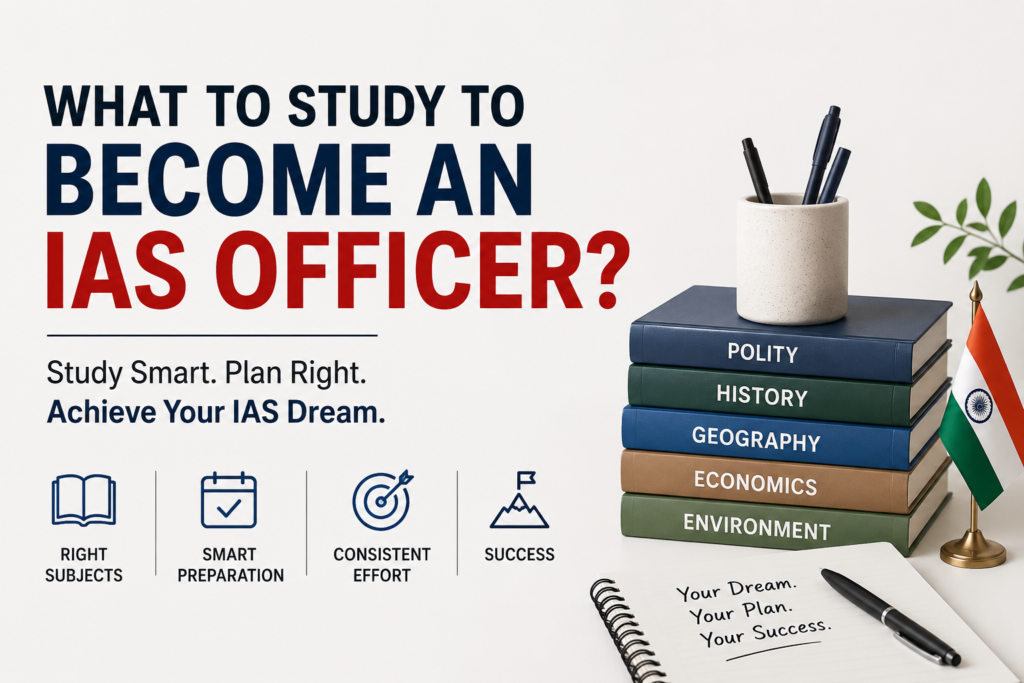
Focus on Polity, History, Geography, Economics, Environment, Science and Technology, Current Affairs, Ethics, Essay Writing, and a carefully chosen Optional Subject.
You don’t need a special degree.
You don’t need expensive coaching to begin.
You need the right direction and consistent effort.
Thousands of students start their UPSC journey every year.
A small percentage stay disciplined long enough to reach the finish line.
The question is:
Will you be one of them?
If you’re preparing for UPSC, tell us in the comments which subject feels hardest right now. Your answer might help another aspirant facing the same challenge.
© 2025 Created & Maintained by PM IAS ACADEMY – Unit of Plover Minds Institute LLP