Many government job aspirants spend months preparing for competitive exams but still get confused about one important question: Is Assistant Labour Commissioner an IAS officer?
If you have seen recruitment notifications for Assistant Labour Commissioner (ALC), you may wonder whether it is an IAS-level position or part of the civil services. This confusion is common because both roles involve administration, public service, and government responsibilities.
Understanding the difference matters. It can help you choose the right career path, prepare for the correct examination, and avoid costly mistakes in your preparation strategy.
The answer may surprise you because there is an important connection between these positions that many candidates overlook.
An Assistant Labour Commissioner (ALC) is a government officer responsible for enforcing labor laws and protecting the rights of workers.
The role typically involves:
Assistant Labour Commissioners work under labor departments at either the state or central government level.
Their primary focus is labor welfare, employment regulations, and industrial relations.
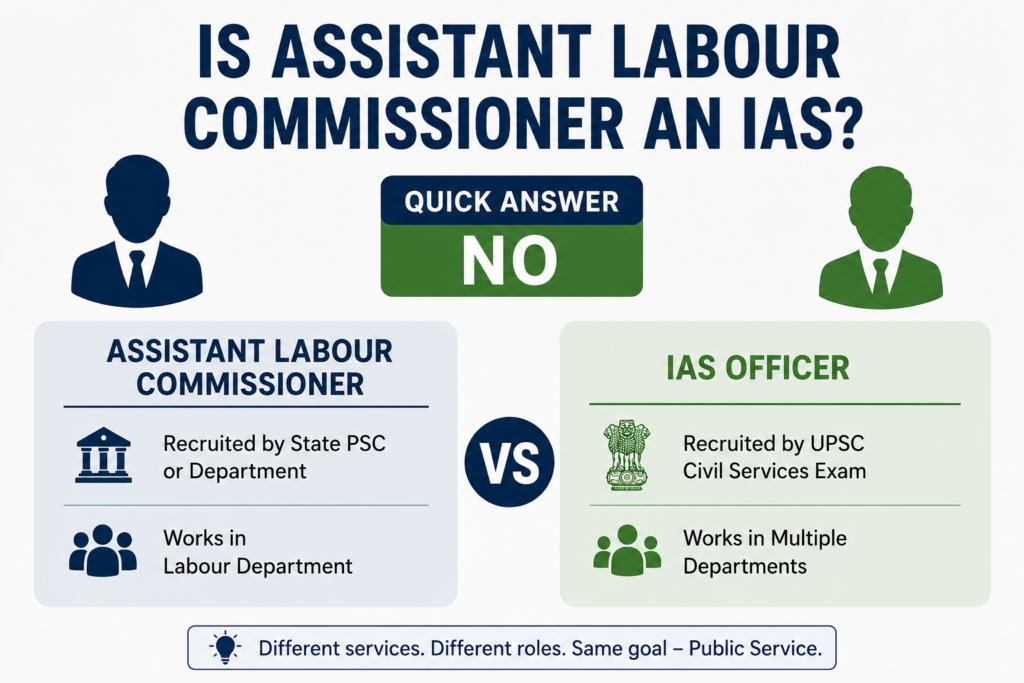
No, an Assistant Labour Commissioner is generally not an IAS officer.
However, the complete picture is slightly more complex, which we will discuss next.
No, an Assistant Labour Commissioner is not typically an IAS officer. The post is usually filled through state public service commissions, departmental promotions, or specialized recruitment processes. IAS officers are recruited through the UPSC Civil Services Examination and belong to the Indian Administrative Service.
While both positions involve administration, they belong to different services and recruitment systems.
Understanding the distinction can save you from preparing for the wrong examination.
| Feature | Assistant Labour Commissioner | IAS Officer |
|---|---|---|
| Recruitment | State PSC, SSC, UPSC specialized exams, departmental recruitment | UPSC Civil Services Examination |
| Service | Labour Department | Indian Administrative Service |
| Primary Work | Labour welfare and industrial relations | General administration and governance |
| Jurisdiction | Labour-related matters | Multiple government departments |
| Career Path | Labour administration hierarchy | Administrative leadership positions |
An IAS officer may work in various departments throughout their career, while an Assistant Labour Commissioner usually specializes in labor administration.

The recruitment process varies depending on the state or department.
Common recruitment methods include:
Many states recruit Assistant Labour Commissioners through examinations conducted by their Public Service Commissions.
Examples include:
Experienced labor officers may receive promotions to the Assistant Labour Commissioner position.
Some labor-related positions under the central government may be filled through recruitment conducted by agencies such as UPSC.
This is where confusion often begins.
Just because UPSC conducts recruitment does not automatically make the position an IAS post.
Yes.
An IAS officer can be appointed to senior positions in the Labour Department, including:
These appointments happen as part of administrative postings.
This is one reason people mistakenly assume that Assistant Labour Commissioner is also an IAS position.
In reality, the department may contain both IAS officers and specialized labor service officers working together.
One factor that attracts candidates to this role is its strong career progression.
A typical career path may include:
The exact hierarchy varies by state and department.
The position offers:
For many aspirants, this makes it an attractive alternative to broader civil services.
Several reasons contribute to this misunderstanding.
Both positions involve:
Both officers exercise significant administrative powers.
Senior labor departments often include IAS officers in leadership roles.
Some labor-related posts are recruited through UPSC, leading candidates to assume they belong to the IAS cadre.
The recruitment agency and service category are not always the same thing.
UPSC recruits for many services besides IAS.
Examples include:
Always check the service category.
Many candidates focus only on the job title and overlook eligibility requirements.
Read the official notification carefully.
Some aspirants begin IAS preparation when the desired post actually requires a state PSC examination.
This can waste valuable preparation time.
Knowing promotion opportunities helps you make informed career decisions.
Research the complete service hierarchy before applying.
Never rely solely on social media discussions or unofficial websites.
The notification contains the most accurate information.
Ask yourself:
Your answer can guide your preparation strategy.
Understanding service structure often gives you a clearer career vision than simply looking at salary or designation.
Many successful officers initially prepared for one service but eventually found rewarding careers in another.
The goal is public service, not just a specific title.
Yes, in most cases, Assistant Labour Commissioner is a Gazetted Officer position under the government.
It depends on the department and recruitment rules. In many cases, the position falls under Group A or equivalent categories.
Certain labor-related posts may be recruited through UPSC, but that does not automatically make them IAS positions.
Yes. It offers stability, respectable authority, career growth, and an opportunity to contribute to labor welfare and industrial relations.
Yes. IAS officers are often posted to labor departments and may hold senior administrative positions.
Generally, IAS is considered a higher all-India administrative service with broader authority and wider career opportunities.
So, is Assistant Labour Commissioner an IAS officer?
The answer is no. Assistant Labour Commissioner is generally a specialized labor administration position, while IAS officers belong to the Indian Administrative Service recruited through the UPSC Civil Services Examination.
Both roles serve the public and contribute to governance, but they follow different recruitment processes, career paths, and responsibilities.
© 2025 Created & Maintained by PM IAS ACADEMY – Unit of Plover Minds Institute LLP