If you are preparing for the UPSC Civil Services Examination, you have probably asked this question:
Who is more powerful — IAS or IPS?
You may hear one person say, “IAS is more powerful.”
Someone else will tell you, “IPS has more authority because they control the police.”
Both answers are incomplete.
The truth is more interesting.
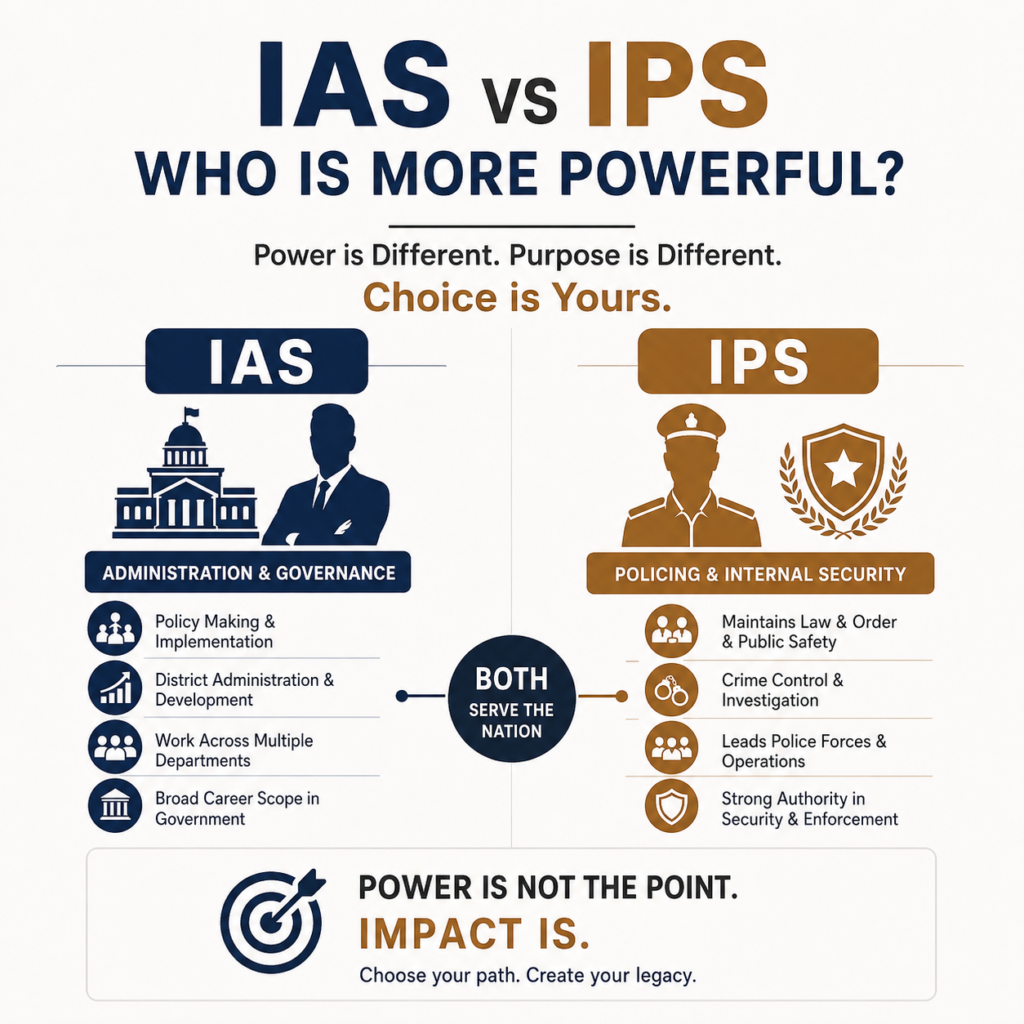
IAS and IPS are both All India Services, but their powers are different because their responsibilities are different. IAS officers are primarily associated with administration, governance and policy implementation. IPS officers provide senior-level leadership to police forces at the state and central levels.
So if you are choosing between IAS and IPS, don’t ask only:
“Which service has more power?”
Ask:
“Which type of power do I actually want?”
That answer can change your entire career decision.
Think about a district facing a serious law-and-order problem.
There may be protests, traffic problems, crime, political pressure and public safety concerns.
The IPS officer is deeply involved in the policing side of the situation — maintaining law and order, leading police operations and managing the police organisation.
The IAS officer, depending on the posting and applicable state laws, may be responsible for broader district administration, coordination and implementation of government decisions.
This is why comparing them like two competitors is misleading.
They operate in different areas.
The Ministry of Home Affairs describes IPS officers as providing senior-level leadership to police forces in the states and at the Centre.
The IAS, meanwhile, has a much broader administrative career structure, including positions such as Collector/District Magistrate, Commissioner and Secretary-level roles.
So the first answer is simple:
But that’s only the beginning.
This is where most UPSC aspirants get confused.
At the district level, you may commonly see an IAS officer serving as District Magistrate/Collector and an IPS officer serving in a senior police role such as Superintendent of Police.
Their responsibilities overlap in areas such as law and order, but they are not doing the same job.
An IAS officer’s district role can involve administration, development programmes, revenue and land administration, public service delivery and coordination across departments.
The training of IAS officers itself includes district administration, law and order, public service delivery and the work of the Collector/District Magistrate.
An IPS officer’s core responsibility is policing.
That includes leadership of police forces, crime control, investigation-related leadership, public order and other police functions.
So who is more powerful?
There is no universal winner.
If you are talking about overall district administration, the IAS role can have wider administrative reach.
If you are talking about police operations and policing authority, the IPS officer has the specialised authority.
And this distinction matters.
Here’s one reason many people consider IAS more powerful.
An IAS officer can work across a wide range of government functions.
Depending on the posting and cadre, IAS officers can hold roles connected with:
The official IAS cadre rules list senior roles including Collector/District Magistrate and a wide range of departmental positions.
This gives IAS officers something important:
breadth.
Your work may move from district administration to a state department and later to a central government role.
That’s a major attraction if you want to influence policy and public administration on a wider scale.

Now let’s reverse the question.
What if your ambition is to lead a police force?
What if you want a career involving:
Then IPS may be the better fit.
The Ministry of Home Affairs identifies itself as the cadre-controlling authority for IPS and oversees matters such as cadre management, training and central deputation.
IPS officers can also rise into senior leadership roles at the state and central levels.
The career can therefore extend far beyond the traditional image of an SP in a district.
This is the part many aspirants miss.
IPS is not simply about wearing a uniform.
It is a long-term leadership career in policing and internal security.
Let’s be honest.
This matters to many aspirants.
You may hear relatives say:
“IAS is the ultimate government job.”
Or someone may say:
“IPS has more respect because of the uniform.”
But social status is subjective.
In some situations, people may perceive the IAS as more influential because of its broad administrative responsibilities.
In other situations, an IPS officer may have greater public visibility because police work is directly connected with crime, security and law enforcement.
Your public image can also depend heavily on your posting.
A senior officer in a major policy position can have a very different level of influence from a junior officer in the field.
So don’t choose your service based only on what sounds impressive at family gatherings.
Choose based on the work you want to do for the next 20–30 years.
This is another common search query.
“Does IAS get more salary than IPS?”
At comparable levels under the applicable pay rules, there isn’t a simple “IAS always earns more” answer.
Both are All India Services, and their pay is governed by the applicable government pay rules.
IPS also has its own pay rules and service-related provisions under the All India Services framework.
Your actual compensation can depend on:
So salary alone should not decide your IAS vs IPS choice.
If money is your only motivation, there are many careers you should compare before committing years to UPSC preparation.
Now we reach the question that actually creates the confusion.
An IAS officer can eventually move into very senior administrative positions, including Secretary-level roles.
An IPS officer can rise to senior police leadership positions, including the highest levels of police command.
The two career paths are therefore different.
Think of it this way:
District Administration → State Administration → Senior Government Departments → Central Government / Policy Roles
Police Leadership → State Police Command → Central Police Organisations / Security Roles → Senior Police Leadership
The Ministry of Home Affairs confirms that IPS officers can be empanelled for senior central deputation positions, including roles at DIG and DG levels, subject to the applicable rules and policies.
So the question isn’t really:
“Who wins — IAS or IPS?”
The better question is:
“Where do you want your authority to come from?”
| Factor | IAS | IPS |
|---|---|---|
| Main area | Administration & governance | Police & internal security |
| District role | Broad administrative responsibilities | Police leadership |
| Law & order | Administrative/coordination role as applicable | Direct policing responsibility |
| Police operations | No | Yes |
| Policy implementation | Major role | Within policing/security domain |
| Public visibility | High | High |
| Uniform | No | Yes |
| Career scope | Very broad across government | Specialised in policing/security, with central opportunities |
| Senior leadership | Administrative leadership | Police leadership |
| Best suited for | Governance & administration | Police, security & command |
Here’s the honest answer.
Neither is simply “more powerful” in every situation.
If you define power as broad administrative control, policy implementation and governance, IAS generally has the wider administrative scope.
If you define power as police command, law enforcement and internal security, IPS has the stronger specialised authority.
And your posting matters.
An officer’s actual authority comes from the post they hold, the laws applicable to that post, their jurisdiction and the responsibilities assigned to them.
That’s why comparing IAS and IPS purely by the word “power” can lead you to the wrong career choice.
Here’s a simple test.
But don’t choose IPS just because you like the uniform.
And don’t choose IAS just because someone told you it is “more powerful.”
You are the person who will have to live with that decision.
Imagine two futures.
In one, you’re sitting in a government office dealing with policy, development, administration and multiple departments.
In the other, you’re leading a police organisation, handling law-and-order challenges and making decisions under pressure.
Which one feels more like the career you actually want?
That answer is more valuable than any “IAS vs IPS power ranking” you find online.
Because clearing UPSC is not the finish line.
It’s the beginning of a career that can last decades.
If you want the shortest possible answer:
IAS has broader administrative authority.
IPS has stronger specialised authority in policing and internal security.
So asking “who is more powerful, IAS or IPS?” without defining the type of power is like asking whether a surgeon or an engineer is more important.
They solve different problems.
Your decision should depend on your interests, strengths, career goals and the kind of responsibility you want to carry.
And if you’re preparing for UPSC, don’t waste months choosing a service based on social-media comparisons.
Understand the services.
Understand the exam.
Then build your preparation around your goal.
Your rank determines your service options. Your preparation determines your rank.
Not in every situation. IAS generally has broader administrative responsibilities, while IPS has specialised authority over policing and internal security.
IAS and IPS are separate All India Services. Officers do not normally switch between the two simply through promotion. Recruitment to IAS and IPS occurs through the UPSC Civil Services Examination, while promotion/selection routes also exist from eligible State services.
It depends on the specific responsibility and applicable state laws. An IAS officer serving as District Magistrate/Collector may have broad administrative responsibilities, while the IPS officer leads the police side.
Neither is universally better. IAS may suit you if you prefer administration and governance. IPS may suit you if you prefer policing, security and operational leadership.
Both are recruited through the UPSC Civil Services Examination. The difficulty of getting a particular service depends on factors such as rank, vacancies, preferences and allocation rules.
Both services carry significant public responsibility and status. Perception varies by location, posting and individual officer. You should not use social status as the main basis for choosing your service.
Don’t choose IAS because it sounds powerful.
Don’t choose IPS because it looks powerful.
Choose the service whose responsibilities match the kind of officer you want to become.
Because after the UPSC result, the question changes from:
“Which service is more powerful?”
to:
“What will you do with the power and responsibility you have?”
© 2025 Created & Maintained by PM IAS ACADEMY – Unit of Plover Minds Institute LLP