Have you ever heard someone say:
“You studied Science. IAS is for Arts students.”
If yes, you’re not alone.
Many students start doubting themselves after choosing Science in Class 11 or engineering in college. They wonder if they made the wrong choice.
Here’s the truth.
Yes, you can absolutely become an IAS officer after taking Science.
In fact, thousands of IAS officers come from Science, Engineering, and Medical backgrounds.
Before you worry about changing your stream or starting over, read these 9 facts. They could save you years of confusion.
Let’s clear the biggest myth first.
UPSC does not ask whether you studied Arts, Commerce, or Science.
To appear for the Civil Services Examination, you generally need:
That’s it.
Your stream does not decide whether you can become an IAS officer.
Here’s something most students don’t know.
A large number of successful IAS officers completed degrees such as:
If they can clear UPSC, so can you.
The exam tests your preparation, not your college branch.
Many students think Science becomes useless after graduation.
That’s not true.
A Science background helps you build skills like:
These skills are useful during both UPSC preparation and the interview.
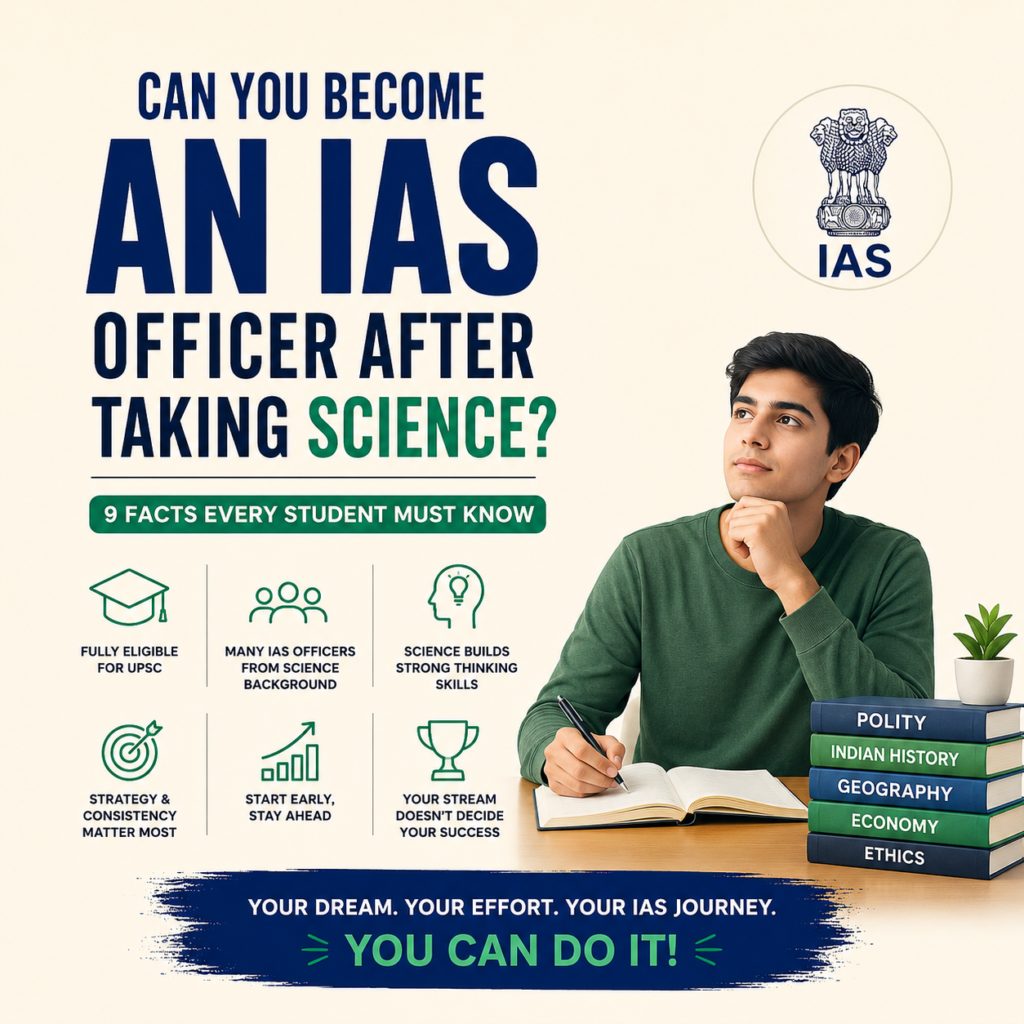

Here’s what surprises most students.
Science isn’t the problem.
The real challenge is learning subjects that may be new to you.
These include:
The good news?
Millions of students learn these subjects from scratch.
You can too.
Many aspirants believe they must leave Science completely.
You don’t.
If your graduation subject is available as an optional subject and you’re comfortable with it, you may choose it.
Or you can select another optional that matches your interest.
Choose based on:
Not because someone told you one subject is easier.
One mistake many Science students make is waiting until graduation.
By then, others may already have covered the basics.
If you’re in Class 11, Class 12, or college, you can start slowly.
Focus on:
Even one hour a day can make a difference over time.
This is where many students lose confidence.
You may see Arts students already familiar with History or Political Science.
That’s okay.
You probably understand analytical subjects much faster.
Everyone has strengths.
UPSC rewards consistent preparation, not your school stream.
Every year, many intelligent students fail.
Not because they lack knowledge.
But because they don’t have a plan.
A good strategy includes:
Small daily improvements matter more than studying for 15 hours once in a while.
Here’s the fact you should remember.
Science doesn’t stop you from becoming an IAS officer.
Neither does Commerce.
Neither does Arts.
Your preparation decides your result.
Thousands of aspirants from different educational backgrounds clear UPSC every year.
The next success story could be yours.
Yes. Students who studied Physics, Chemistry, and Mathematics are fully eligible after completing a bachelor’s degree.
Yes. Medical and Biology students regularly clear the UPSC Civil Services Examination.
Absolutely.
Engineering graduates make up a significant number of UPSC aspirants every year.
Neither is better.
Each stream has advantages.
What matters is how well you prepare.
There is no compulsory degree.
Popular choices include:
Choose a degree you genuinely want to study.
Imagine two students.
One studied History.
The other studied Mechanical Engineering.
The History student already knows some parts of the syllabus.
The Engineering student learns them over time.
Both write the same UPSC exam.
Both answer the same questions.
Both attend the same interview.
UPSC doesn’t give extra marks because of your degree.
It only checks your performance.
If you’re waiting for the “right time,” don’t.
Start with small steps.
One year from now, you’ll be glad you started today instead of waiting.
Many students waste months trying to figure out what to study first.
A structured roadmap can save you time and help you avoid common mistakes.
If you’re serious about becoming an IAS officer, learning from experienced mentors, following a planned study schedule, taking regular mock tests, and getting feedback on your answers can make your preparation more focused.
Whether you’re in Science, Commerce, or Arts, the right guidance can help you study smarter—not just longer.
So, can you become an IAS officer after taking Science?
Yes. Without any doubt.
Don’t let myths stop you before you even begin.
Your stream is just your starting point.
Your discipline, consistency, and preparation will decide where you finish.
What about you?
Are you studying Science and planning to prepare for UPSC?
Share your biggest question in the comments. It might help another student who has the same doubt.
© 2025 Created & Maintained by PM IAS ACADEMY – Unit of Plover Minds Institute LLP