Think science students can’t crack the UPSC Civil Services Exam?
That’s one of the biggest myths many students still believe.
Every year, thousands of science students ask the same question:
“Can i become an IAS officer if i studied Science?”
The short answer is yes.
The better question is this:
Can you use your science background as an advantage instead of thinking it’s a weakness?
This guide shows you exactly how.
By the end, you’ll know:
Let’s begin.
Yes.
Your Class 11 and 12 stream has no impact on UPSC eligibility.
Whether you studied:
…you can become an IAS officer if you meet the UPSC eligibility criteria and clear all three stages of the exam.
Many successful IAS officers came from engineering, medicine, and other science backgrounds.
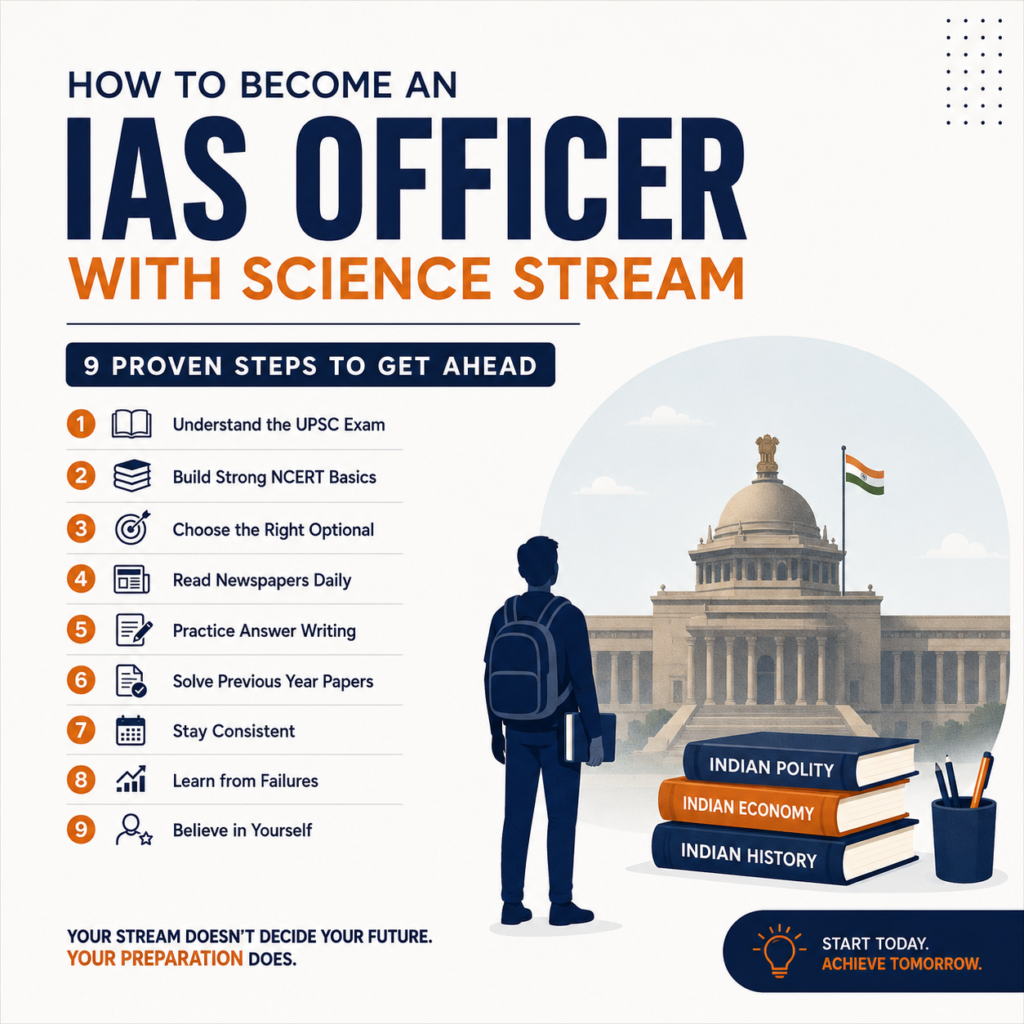
Your stream does not decide your future.
Your preparation does.
This usually happens because people keep saying things like:
“UPSC is only for Arts students.”
After hearing this enough times, you start believing it.
Then doubts appear.
Here’s the truth.
Every UPSC topper starts with subjects they don’t know.
Nobody is born knowing Indian Polity or Ancient History.
Everyone learns them from scratch.
So can you.
Many students begin buying books immediately.
That’s a mistake.
First understand the exam.
UPSC has three stages.
When you understand the exam, your preparation becomes focused.

This mindset hurts more students than any subject.
Science students already have strengths like:
These skills help throughout UPSC preparation.
Your challenge isn’t intelligence.
It’s adapting to reading and writing more.
And that’s completely learnable.
Before expensive coaching…
Before advanced books…
Finish NCERT textbooks.
Focus on:
These books make advanced preparation much easier.
Many aspirants skip this step.
Don’t.
This is where many students overthink.
Don’t choose an optional because someone else scored well.
Choose based on:
If you’re from science, options may include:
Pick one you’ll enjoy studying for a year.
Not one that simply looks “high scoring.”
UPSC doesn’t test memory alone.
It tests awareness.
Spend around one hour daily reading national news.
Focus on:
Don’t read everything.
Read what matters.
Here’s something many students realize too late.
Knowing the answer isn’t enough.
You must write it clearly.
Start with one answer every day.
Then increase slowly.
Good writing improves:
Small daily practice creates a huge difference after a few months.
Want to know what UPSC really asks?
Read previous papers.
You’ll notice patterns.
You’ll understand:
Many toppers say previous papers changed their preparation strategy.
You don’t need 16-hour study days.
You need regular study.
Even 6–8 focused hours daily beat random 14-hour sessions followed by burnout.
Consistency wins.
Every single time.
Most successful IAS officers didn’t clear UPSC on their first attempt.
They improved after every setback.
If a mock test goes badly…
Don’t panic.
Find the reason.
Fix it.
Move forward.
That’s how progress happens.
Choosing the right optional can improve your chances.
Here’s a quick comparison.
| Optional Subject | Best For |
|---|---|
| Mathematics | Students who enjoy problem-solving |
| Physics | Physics graduates |
| Chemistry | Chemistry graduates |
| Anthropology | Popular among engineers and doctors |
| Geography | Good overlap with General Studies |
| Sociology | Easy to understand and score well with good writing |
| Psychology | Students interested in human behavior |
There is no “perfect” optional.
Only the right optional for you.
Avoid these mistakes.
Many students think,
“I’ll prepare after graduation.”
But one extra year of preparation can make a huge difference.
Reading alone won’t help in Mains.
Writing is equally important.
More books don’t mean more marks.
Study fewer books multiple times.
Different strategies work for different people.
Create your own plan.
Comparison creates stress.
Progress creates confidence.
Focus on your own improvement.
If you’re starting today, follow this order.
Month 1–2
Month 3–5
Month 6 onwards
Simple plans are easier to follow.
In some areas, yes.
Science students often perform well in:
But Arts students often have stronger writing skills early on.
The good news?
Writing can be improved with practice.
So no stream has a permanent advantage.
If you’re waiting for someone to tell you that science students can become IAS officers, here it is.
Yes, you can.
Your stream doesn’t decide your result.
Your daily habits do.
Start now.
Read one chapter today.
Write one answer today.
Solve one previous question today.
A year from now, you’ll either be glad you started—or wish you had.
The choice is yours.
Yes. Science students are fully eligible to appear for the UPSC Civil Services Examination if they meet the eligibility criteria.
It depends on your interest, graduation subject, and writing ability. Mathematics, Anthropology, Geography, Sociology, Physics, and Chemistry are popular choices.
Not because of the science background. The challenge is learning humanities subjects and improving answer writing, both of which can be developed with practice.
Yes. Students from Physics, Chemistry, and Mathematics backgrounds regularly clear UPSC and join the IAS.
Absolutely. Many doctors and biology graduates have successfully become IAS officers.
Don’t wait until graduation or after someone else succeeds.
The earlier you begin, the more confident you’ll become.
If you want structured guidance, expert mentoring, quality study materials, mock tests, current affairs, and a preparation plan that keeps you on track, join PMIAS.
Thousands of aspirants lose valuable time trying to figure everything out on their own. You don’t have to.
Explore PMIAS programs today and take the first step toward becoming an IAS officer with confidence.
© 2025 Created & Maintained by PM IAS ACADEMY – Unit of Plover Minds Institute LLP