Every UPSC aspirant asks this question at least once.
“Is IAS bigger than IPS?”
Maybe you’ve heard people say:
So who’s right?
The answer isn’t as simple as picking one over the other.
If you’re preparing for UPSC, this article could save you from making decisions based on myths instead of facts.
Let’s clear the confusion.
Yes.
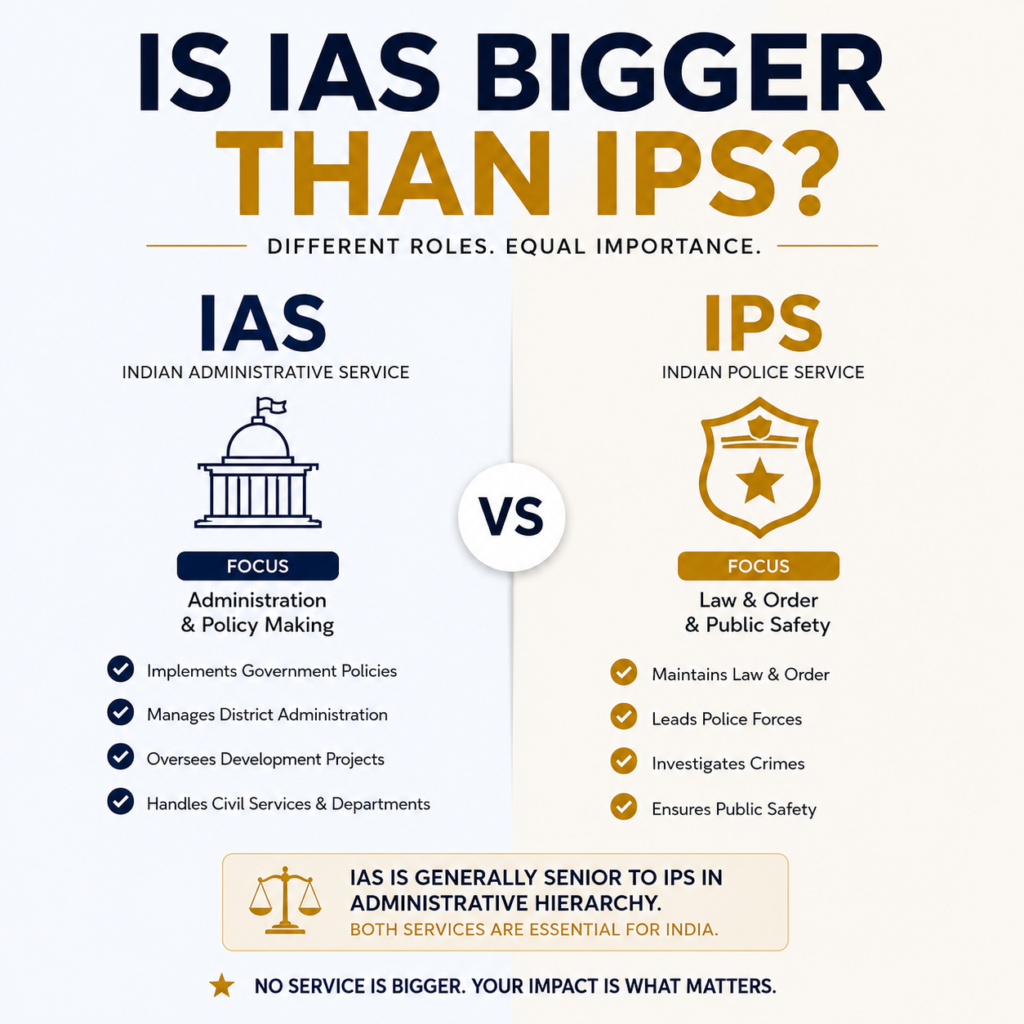
IAS is generally considered senior to IPS in the administrative hierarchy.
But that doesn’t mean IPS officers are less important.
Both services are among India’s most prestigious civil services. They simply handle different responsibilities.
Think of it like this.
Both are essential for running the country.
It’s easy to understand why.
People see:
This creates the impression that IPS officers have more authority.
But real power in government is not only about public visibility.
Many important decisions happen inside government offices.
That’s where IAS officers play a major role.
| Feature | IAS | IPS |
|---|---|---|
| Service | Indian Administrative Service | Indian Police Service |
| Main Role | Administration and policy | Police and law enforcement |
| Cadre Control | Department of Personnel & Training | Ministry of Home Affairs |
| Field Work | Administration | Police operations |
| Uniform | No | Yes |
| Highest Position | Cabinet Secretary | Director General of Police (State) |

Yes.
In the order of precedence and administrative hierarchy:
IAS officers generally rank above IPS officers.
For example:
A District Magistrate (IAS) coordinates administration for the district.
The Superintendent of Police (IPS) is responsible for policing.
Both work together.
But many district-level administrative decisions are coordinated through the District Magistrate.
This doesn’t mean the IAS officer controls police investigations.
The IPS officer has operational independence in policing matters.
This depends on what you mean by “power.”
An IAS officer may:
Their decisions affect education, health, transport, revenue, and welfare.
An IPS officer may:
They have significant powers under criminal law.
There isn’t one answer.
If your goal is administration, IAS has broader authority.
If your goal is policing and public safety, IPS has specialized authority.
Many students assume IAS officers earn much more.
That’s not true.
Both IAS and IPS officers follow the 7th Central Pay Commission pay structure.
Basic salary levels are broadly similar because both belong to the All India Services.
Differences usually come from:
So salary should not be your deciding factor.
This question has no fixed answer.
Respect comes from your work.
An honest IAS officer earns immense public trust.
An efficient IPS officer who reduces crime also earns tremendous respect.
Across India, both services are highly respected.
Both are demanding.
Face pressure from:
Handle:
Choose the challenge that matches your personality.
Generally:
IAS officers may have more predictable schedules in some postings.
IPS officers often deal with emergencies at any hour.
Crime doesn’t follow office timings.
If work-life balance matters to you, it’s worth considering before choosing a service.
Ask yourself these questions.
There is no “best” choice.
There is only the right choice for you.
Not exactly.
Both have different legal responsibilities.
False.
Their pay structure is broadly similar.
No.
Every officer works within laws, rules, and constitutional limits.
Wrong.
IPS officers also handle intelligence, cybersecurity, disaster response, VIP security, counter-terror operations, traffic management, and police administration.
Both offer outstanding career opportunities.
IAS officers may rise to senior administrative positions, including the Cabinet Secretary, the highest-ranking civil servant in the Government of India.
IPS officers can become Director General of Police (DGP) in a state or hold senior positions in organizations such as the CBI, Intelligence Bureau, NIA, CRPF, BSF, CISF, and other central police organizations.
Career growth depends on:
Yes.
From an administrative hierarchy perspective, IAS is generally considered senior to IPS.
But bigger does not always mean better.
An IAS officer manages governance.
An IPS officer protects law and order.
India needs both.
If you’re preparing for UPSC, don’t choose a service because someone said it’s “more powerful.”
Choose the one that matches your interests, strengths, and long-term career goals.
That decision will matter far more than the title.
Yes. In the administrative hierarchy, IAS officers are generally senior to IPS officers, though each service has distinct legal responsibilities.
Not overall. IPS officers have significant policing and investigative powers, while IAS officers have broader administrative authority.
Both follow similar pay scales under the 7th Central Pay Commission. Total compensation varies by posting and allowances.
No. The Cabinet Secretary is traditionally appointed from the IAS.
Both are challenging in different ways. IAS focuses on administration and governance, while IPS involves policing, investigations, and emergency response.
Many UPSC aspirants spend months debating IAS vs IPS.
But here’s the truth.
Your rank in the UPSC exam, your dedication, and your commitment to public service will have a much bigger impact on your career than the comparison itself.
So instead of asking, “Is IAS bigger than IPS?”, ask yourself:
“Which role will allow me to serve the country in the best way?”
That’s the question that truly matters.
© 2025 Created & Maintained by PM IAS ACADEMY – Unit of Plover Minds Institute LLP