If you’re preparing for UPSC, one question has probably crossed your mind:
“What is the salary of an IAS officer per month?”
It’s a fair question.
After years of preparation, you want to know if the job is financially worth it. You also want to know what life actually looks like after clearing one of India’s toughest exams.
But here’s the problem.
Many websites only mention one salary number. They don’t explain what an IAS officer actually receives in hand, how the salary grows, or the benefits that make the job valuable.
By the end of this article, you’ll know:
Let’s start with the number everyone wants to know.
The starting basic salary of an IAS officer is ₹56,100 per month under the 7th Central Pay Commission.
But that’s not the amount you receive in your bank account.
Your monthly earnings also include several allowances, such as:
Because of these additions, the gross monthly salary is usually much higher than the basic pay.
The exact amount depends on:
| Component | Amount |
|---|---|
| Basic Pay | ₹56,100 |
| Dearness Allowance | As per government rates |
| House Rent Allowance | Depends on posting |
| Travel Allowance | Applicable |
| Other Allowances | Varies |
| Gross Salary | Higher than basic pay |
Keep in mind that deductions such as income tax, National Pension System (NPS), and other contributions reduce the final in-hand salary.
This is what most aspirants actually want to know.
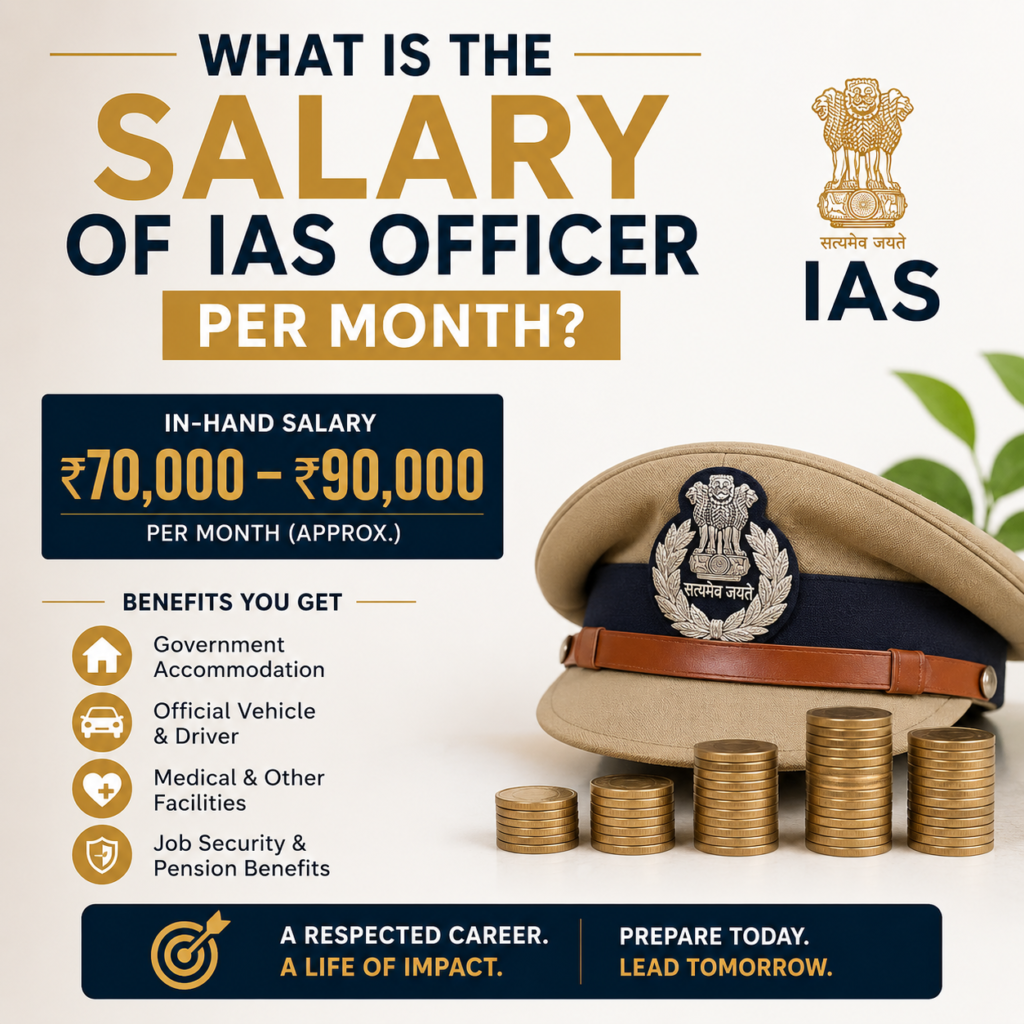
Depending on your posting and deductions, a newly appointed IAS officer generally receives an in-hand salary of around ₹70,000 to ₹90,000 per month.
The figure can be lower or higher based on:
So if someone tells you every IAS officer earns exactly the same amount, that’s not true.

One reason many candidates choose the IAS is long-term career growth.
Here’s how the basic pay increases with seniority.
| Position | Approx. Basic Pay |
| IAS Officer (Entry Level) | ₹56,100 |
| Senior Time Scale | ₹67,700 |
| Junior Administrative Grade | ₹78,800 |
| Selection Grade | ₹1,18,500 |
| Super Time Scale | ₹1,44,200 |
| Principal Secretary | ₹2,25,000 |
| Cabinet Secretary | ₹2,50,000 |
The salary grows steadily as you gain experience and move into higher administrative positions.
Here’s something many people overlook.
The monthly salary is only one part of the package.
IAS officers also receive several government facilities.
These may include:
If you compare these benefits with private sector expenses, their overall value is substantial.
There’s no single answer.
Some private-sector professionals earn much more.
But salary isn’t the only reason people prepare for UPSC.
Many choose the IAS because it offers:
If your goal is only the highest salary, the private sector may offer faster financial growth.
If you want responsibility, public service, and long-term stability, the IAS remains one of India’s most respected careers.
Here’s an honest question.
If UPSC preparation takes two to five years, would you continue if the salary stayed exactly the same?
Most successful IAS officers will tell you that money alone isn’t enough motivation.
Preparing for UPSC requires patience, discipline, and consistency.
The salary is a reward.
But the work, responsibility, and impact are what keep people in the service.
The starting basic salary is ₹56,100 per month under the 7th Pay Commission.
The in-hand salary generally ranges between ₹70,000 and ₹90,000 per month, depending on allowances and deductions.
Yes. Salary increases through annual increments, DA revisions, and promotions.
The Cabinet Secretary of India receives a basic pay of ₹2,50,000 per month, which is the highest level in the IAS pay structure.
Yes. Most IAS officers are provided government accommodation according to their posting and rank.
When people search “What is the salary of an IAS officer per month?”, they’re often looking for one number.
But now you know the bigger picture.
Yes, the starting basic pay is ₹56,100 per month.
Yes, the in-hand salary is generally ₹70,000–₹90,000 per month.
And yes, the career offers benefits that go well beyond salary.
If you’re preparing for UPSC, don’t judge the career only by the monthly paycheck.
Look at the opportunities, responsibilities, and long-term growth that come with the role.
Thousands of aspirants spend years searching for the right strategy.
You don’t have to.
At PMIAS Academy, you get:
If you’re serious about becoming an IAS officer, start with the right guidance today.
Your UPSC journey begins with one decision. Make it count.
© 2025 Created & Maintained by PM IAS ACADEMY – Unit of Plover Minds Institute LLP