Have you ever wondered whether becoming an IAS officer is financially rewarding, or is it only about prestige and public service?
If you’re preparing for the UPSC Civil Services Examination, this question has probably crossed your mind. Knowing what is the starting salary of IAS officers helps you set realistic expectations, compare career options, and understand the long-term value of joining the Indian Administrative Service.
The answer isn’t just a single number. Along with the basic salary, IAS officers receive several allowances, government facilities, and career progression benefits that significantly increase their overall earnings. Let’s break everything down in simple terms.
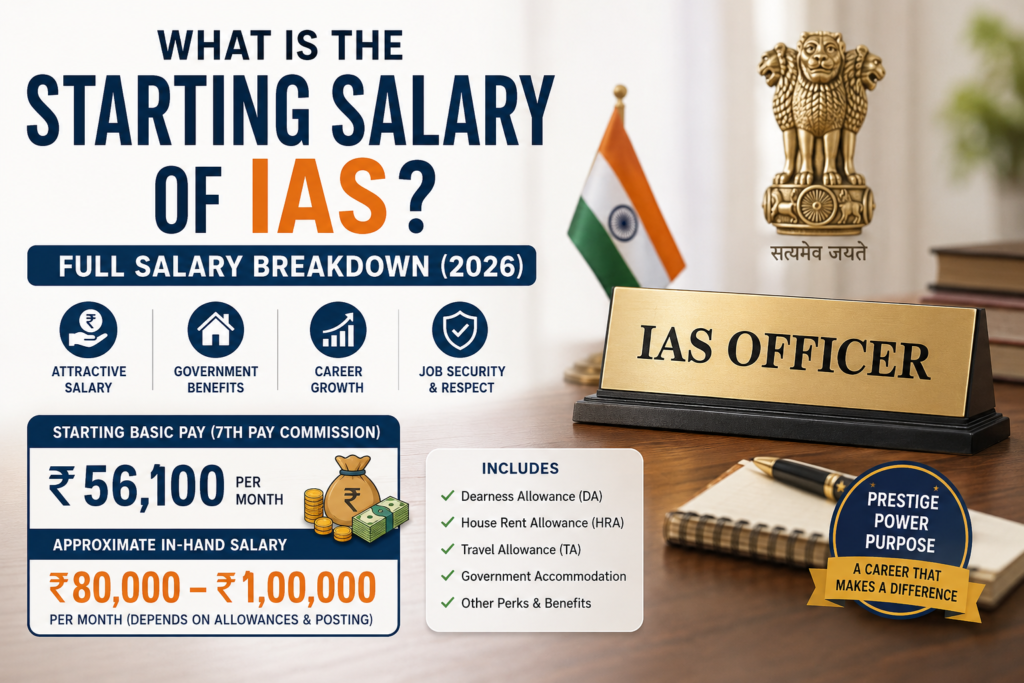
The starting basic salary of an IAS officer is ₹56,100 per month under the 7th Central Pay Commission.
However, this is only the basic pay. After adding various allowances, the monthly in-hand salary usually ranges between ₹80,000 and ₹1,00,000, depending on the posting location, deductions, and applicable benefits.
| Salary Component | Amount |
|---|---|
| Basic Pay | ₹56,100/month |
| Dearness Allowance (DA) | As per current government rates |
| House Rent Allowance (HRA) | Based on posting city |
| Travel Allowance (TA) | Applicable |
| Approximate In-Hand Salary | ₹80,000–₹1,00,000/month |
This makes the IAS one of the most financially secure government careers in India.
Many aspirants focus only on the basic pay. That’s a common mistake.
An IAS officer’s salary consists of several components.
The fixed salary determined by the pay matrix.
DA is revised periodically to help officers cope with inflation.
If government accommodation isn’t provided, HRA is paid based on the city classification.
This covers official travel and transportation expenses.
Depending on the role and location, officers may receive additional allowances and facilities.
Many students assume the government can simply recruit more officers. The reality is more complex.
IAS vacancies depend on:
As senior officers retire, new vacancies are created.
Each state cadre has a fixed administrative structure.
Recruitment numbers may increase or decrease based on administrative needs.
Some IAS positions are filled through promotions from state civil services.
Because of these factors, the number of IAS vacancies remains limited.

One reason many aspirants choose the IAS is steady career progression.
As officers receive promotions, both their responsibilities and salaries increase.
| Position | Approximate Basic Pay |
| Junior Scale | ₹56,100 |
| Senior Time Scale | ₹67,700 |
| Junior Administrative Grade | ₹78,800 |
| Selection Grade | ₹1,18,500 |
| Super Time Scale | ₹1,44,200 |
| Additional Secretary | ₹2,05,400 |
| Secretary | ₹2,25,000 |
| Cabinet Secretary | ₹2,50,000 |
Besides salary growth, senior positions also come with greater administrative authority.
The starting salary is only part of the overall compensation.
IAS officers often receive several government-supported facilities.
These may include:
These benefits reduce personal expenses and improve financial stability.
Not exactly.
Several factors affect the final in-hand salary.
These include:
For example, an IAS officer posted in a metro city may receive different allowances compared to one posted in a rural district.
This question has no single answer.
If your only goal is earning the highest possible income, the private sector may offer larger packages in some industries.
However, the IAS offers something different:
Many aspirants value these factors just as much as salary.
The basic salary doesn’t represent total monthly earnings.
The salary increases substantially through promotions and periodic pay revisions.
Private-sector salaries may be higher initially, but government benefits and long-term security create a different financial picture.
Allowances vary depending on location and role.
Usually between 150 and 200 candidates are allotted to the IAS through the UPSC Civil Services Examination.
The total number generally ranges from 700 to 1,100 vacancies, including multiple civil services.
Top-ranked candidates usually get IAS if they choose it as their preferred service.
Yes. Vacancy numbers depend on government requirements, retirements, cadre strength, and policy decisions.
IAS and IPS are allotted based on rank and preference. Both services are highly competitive and prestigious.
Typically around 2,000 to 3,000 candidates are called for the Personality Test.
If you’re preparing for the IAS, keep these points in mind.
Salary matters, but responsibilities, learning opportunities, and career satisfaction matter too.
Government pay structures and allowance rates are revised periodically. Always refer to official notifications for the latest figures.
The Civil Services Examination requires years of preparation. Public service should remain one of your primary motivations.
Understanding salary, deductions, and savings can help you manage your finances better once you join the service.
The starting basic salary of an IAS officer is ₹56,100 per month under the 7th Pay Commission. The in-hand salary is generally between ₹80,000 and ₹1,00,000 per month, depending on allowances and deductions.
The Cabinet Secretary receives the highest salary, with a basic pay of ₹2,50,000 per month.
Yes. In many postings, eligible IAS officers receive government accommodation or a house rent allowance if accommodation is unavailable.
Yes. Salary increases through annual increments, promotions, revised DA rates, and future pay commission recommendations.
Yes. IAS officers pay income tax according to the applicable tax laws.
The answer to what is the starting salary of IAS is more than just the basic pay of ₹56,100 per month. When allowances, facilities, and long-term career growth are included, the overall compensation becomes significantly more attractive.
If you’re preparing for UPSC, don’t evaluate the IAS only by its salary. Consider the responsibility, stability, career progression, and opportunity to serve the country.
Actionable takeaway: Review the complete salary structure—not just the starting pay—before deciding whether the IAS aligns with your career goals.
What motivates you more: the salary, the job security, or the opportunity to make a difference? Share your thoughts in the comments, and if you found this guide useful, consider sharing it with other UPSC aspirants.
© 2025 Created & Maintained by PM IAS ACADEMY – Unit of Plover Minds Institute LLP