Most students figure out they want to crack UPSC only after wasting 2-3 years in the wrong
degree. You’re asking this question right after 10th. That puts you miles ahead.
But here’s the problem — there’s too much noise out there. Everyone has an opinion. Your
relatives say Engineering. Your school says Science. Your neighbour’s kid took Arts and
cracked IAS in the first attempt.
So what’s actually true?
“The course you pick after 10th won’t make or break your IAS dream — but
picking the right one does make the journey 3x easier.”
Let’s cut through the confusion.
Before picking a course, you need to understand what the IAS exam (UPSC CSE) actually looks
for.
The exam has three stages:
1. Prelims — objective, tests GK, current affairs, reasoning
2. Mains — written essays, general studies, optional subject
3. Interview — personality, communication, awareness
UPSC doesn’t care if you did B.Tech or B.A. — any graduate can appear. What matters is how
well you understand history, polity, economy, geography, science, ethics, and current affairs.
So the question isn’t “which course guarantees IAS.” The right question is: “which course builds
the strongest foundation for UPSC preparation?”
“Spoiler: It’s not always Engineering.”
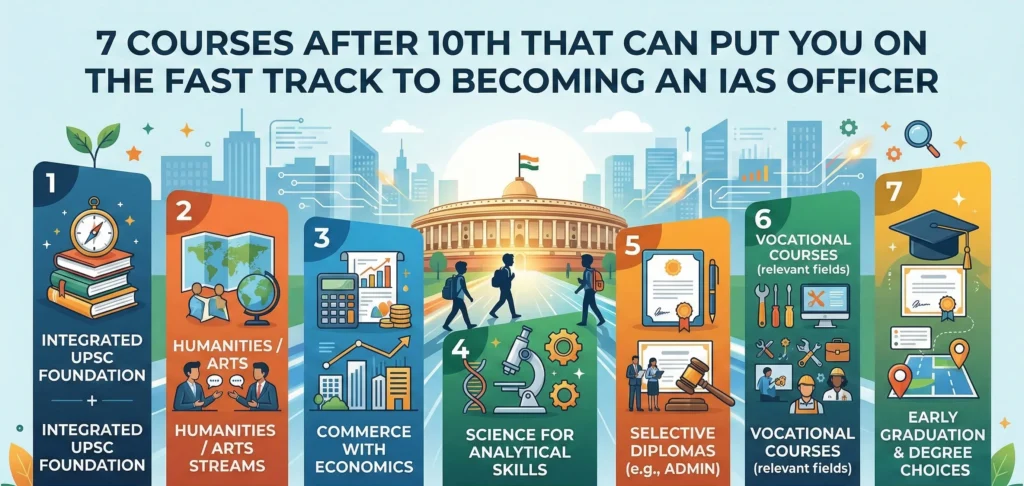
This is the most direct path. And yes, it still carries a social stigma in India. That’s a mistake.
Arts gives you direct exposure to History, Political Science, Geography, Economics, Sociology
— subjects that form the backbone of UPSC GS papers. Students from Arts stream often need
less additional preparation because they’ve studied the right things already.
Best for: Students who enjoy reading, writing, and have clarity about IAS as a goal.
After 12th: BA in History, Political Science, Public Administration, Geography, or Sociology.
Advantage: Your graduation syllabus and UPSC syllabus overlap heavily. Less extra study
needed.
Risk: Career options outside UPSC are limited if you change your mind later.

Science gives you strong analytical thinking. The optional subjects Physics, Chemistry, or
Mathematics can be used in UPSC Mains — and they’re scoring if you’re good at them.
But here’s the catch: Science students often struggle with History and Polity because they’ve
never studied them formally. You’ll need to put in extra time for those areas.
Best for: Students strong in Sciences who want IAS but want a backup career option too.
After 12th: BSc or integrated BSc-MSc. Choose optional subjects wisely.
Advantage: Strong analytical base. Science optionals can be highly scoring.
Risk: You’ll need to self-study History, Polity, Economy from scratch.
Commerce is underrated for IAS prep. Economics, Business Studies, and Accountancy build
financial awareness — directly useful for GS Paper 3 (Economy).
Best for: Students interested in economic policy, governance, and public finance.
After 12th: BCom, BBA, or BA Economics.
Advantage: Economy is a major part of UPSC. Commerce students have a head start.
Risk: History, Geography, and Polity still need to be covered independently.
This is the path most Indian families push. And to be fair, many IAS toppers are engineers.
But here’s what no one tells you: Engineers who crack IAS do so despite their degree, not
because of it. They spend years unlearning technical thinking and relearning the broad,
analytical, humane perspective UPSC demands.
Best for: Students who genuinely want engineering as a backup, not those doing it “just in
case.”
Advantage: Respected degree, good optional subjects (like Electrical/Civil/Mechanical
Engineering for UPSC Mains).
Risk: 4 years of study with very little overlap with UPSC syllabus. Time-consuming to switch
gears.
“If your only reason for taking Engineering is your parents’ pressure and you
secretly want IAS — you’re setting yourself up for 7-8 wasted years.”
Law is one of the most underrated choices for IAS aspirants. Constitutional law, administrative
law, and legal reasoning directly align with UPSC’s Polity and Ethics papers.
Best for: Students who enjoy argument, logic, and want to understand how governance actually
works.
After 12th: 5-year BA LLB from a good NLU or state law college.
Advantage: Strong conceptual base for Polity, Ethics, and Essay papers. Great backup career.
Risk: Heavy workload. Need to balance law studies with UPSC preparation.
Medical graduates do appear for UPSC, and some crack it. But it’s an expensive, long, and
mentally exhausting path if UPSC is your primary goal.
Medicine makes sense only if you genuinely love the field and want IAS as an additional
achievement — not as your only goal.
Optional subject advantage: Medical Science is a highly scoring optional in UPSC Mains.
“Unless you’re passionate about medicine, don’t take MBBS just to have a “safe”
degree. It costs too much time.”
These are directly aligned with what an IAS officer actually does — policy, governance,
community work, administration.
Best for: Students already certain about public service as a career.
Advantage: Conceptual foundation in governance that most other courses lack.
Risk: Less awareness about this course. Limited availability at top colleges.
They pick a course based on family pressure or social status — not based on what aligns with
their actual goal.
Here’s what that looks like:
• Takes PCM because “science is prestigious”
• Spends 2 years struggling with Physics and Chemistry
• Gets an Engineering admit, realizes it’s not for them
• Finishes 4-year degree with zero UPSC preparation
• Spends 2-3 more years covering what Arts students knew in year one
That’s 6-7 years of delay. All because of one wrong choice at 16.
“Your goal is IAS, not a “respectable” degree. Pick the course that serves your
goal — not the one that impresses your relatives.”
Tina Dabi, AIR 1 in UPSC CSE 2015, did her schooling in Delhi and then took BA (Honours) in
Political Science from Lady Shri Ram College, Delhi University.
She didn’t do Engineering. She didn’t do Medicine. She picked the course that aligned with what
UPSC tests — and she studied it seriously.
That’s it. No magic formula. Just clarity + alignment + consistency.
You can do this too. You just need to start with the right foundation.
1. Read UPSC’s official syllabus. Download it from upsc.gov.in and understand what
subjects are tested. 30 minutes of reading now can save you 3 years.
2. Start reading a newspaper daily. The Hindu or Indian Express. Even 30 minutes a day
builds current affairs awareness that most students start 3 years too late.
3. Pick the stream that excites you. If History makes you curious, take Arts. If Economics
fascinates you, take Commerce. Passion matters more than prestige.
4. Aim for a reputed college. DU, BHU, Jadavpur, Hyderabad Central, AMU — these
colleges have strong UPSC cultures and alumni networks. The environment matters.
5. Don’t start coaching yet. At Class 10-12, build fundamentals. UPSC coaching makes
sense only in your final year of graduation or after. Anyone asking you to join a 4-year
UPSC coaching program at age 16 is selling you something, not helping you.
No. Any graduate can apply for UPSC. But Arts makes UPSC preparation significantly easier
because the subjects overlap.
Absolutely. Thousands have. But they need extra time to cover humanities subjects that
Arts/Law students already know.
Pick based on interest and scoring trend. Popular ones: PSIR, History, Geography, Sociology,
Public Administration, Law, and some Science subjects. Decide in your final year of graduation
— not now.
Yes. UPSC only requires a graduation degree from a recognized university. Your 10th and 12th
board doesn’t matter as long as you complete a recognized degree.
Less than you think. Consistency, reading habits, and clear thinking matter far more. Many IAS
toppers were average students in school.
There’s no single “best” course for IAS after 10th. But there’s a best course for YOU — and it
depends on your interests, your strengths, and how honest you’re willing to be with yourself.
If you love humanities: Arts + BA is your path.
If you love reasoning and law: BA LLB is your path.
If you love economics: Commerce + BA Economics is your path.
If you’re good at sciences but want IAS too: BSc with a plan works
“The students who crack IAS aren’t necessarily the smartest. They’re the ones
who started with clarity — and you just got some.”
© 2025 Created & Maintained by PM IAS ACADEMY – Unit of Plover Minds Institute LLP