If you’re asking “Which subject is best for IAS?”, you’re probably worried about making the wrong choice.
And that’s a valid fear.
Many IAS aspirants spend months studying a subject they later regret. Not because the subject is hard. But because it wasn’t the right fit for them.
The good news?
You don’t need the “highest-scoring” subject.
You need the subject that gives you the best chance to clear the UPSC Civil Services Examination.
This guide will help you choose with confidence.
Imagine two students.
The first chooses a subject because everyone says it’s scoring.
The second chooses a subject based on interest, background, syllabus, and available resources.
Who has a better chance after one year?
Usually, the second student.
Why?
Because UPSC is not a one-month exam. It’s a long journey. If you don’t enjoy your subject even a little, staying consistent becomes difficult.
That’s why choosing the right subject is one of the biggest decisions you’ll make.
This surprises many beginners.
People often ask:
Here’s the truth.
Every year, successful candidates come from different optional subjects.
History.
Geography.
Political Science.
Sociology.
Anthropology.
Mathematics.
Literature.
Even Agriculture.
If one subject guaranteed success, everyone would choose it.
They don’t.
Because UPSC rewards preparation—not the subject itself.
Ask yourself one question.
Can you read this subject for the next 12 months without getting bored?
If the answer is no, think again.
Interest matters because you’ll read the same topics many times.
Revision becomes easier when you enjoy learning.
If every study session feels like a burden, your motivation slowly disappears.
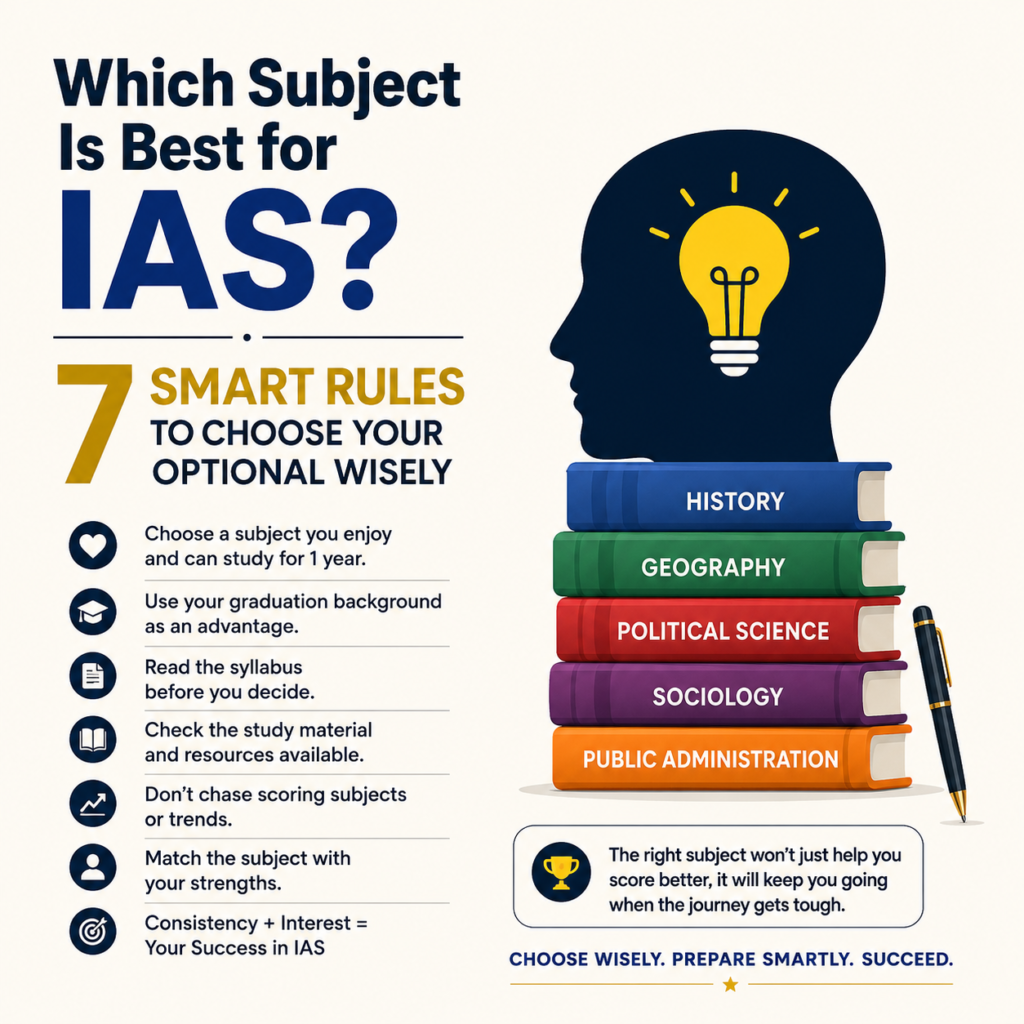

Did you study:
Then your graduation subject might already give you a head start.
You already know the basics.
That means less time learning from scratch.
But don’t choose it automatically.
Some students dislike their graduation subject.
If that’s you, look at other options.
Here’s a mistake many beginners make.
They choose a subject after watching one YouTube video.
Instead, download the official syllabus.
Read every topic.
Ask yourself:
This simple step saves months of confusion.
Some subjects have excellent books, coaching support, test series, and answer-writing resources.
Others don’t.
Before choosing a subject, check whether you can easily find:
Good resources reduce unnecessary stress.
Every year, social media starts a new trend.
“This is the highest-scoring optional.”
“This subject is the easiest.”
“Everyone is switching.”
Don’t fall for it.
A subject becomes “scoring” only when you prepare well.
An average student with the right preparation often scores better than someone who blindly follows trends.
Choose wisely—not emotionally.
Think about how you learn best.
Do you enjoy:
Subjects like History may suit you.
Geography could be a good choice.
Sociology may interest you.
Political Science might fit.
Mathematics can be an option.
Know yourself before choosing.
That’s often the smartest strategy.
| Subject | Best For |
|---|---|
| History | Students who enjoy historical events and analysis |
| Geography | Visual learners who like maps and diagrams |
| Sociology | Beginners looking for a relatively compact syllabus |
| Political Science | Those interested in governance and international relations |
| Anthropology | Students wanting a concise syllabus with science and social topics |
| Public Administration | Candidates interested in administration and public policy |
| Mathematics | Students with strong problem-solving skills |
| Commerce & Accountancy | Commerce graduates |
| Agriculture | Agriculture graduates and professionals |
| Literature | Candidates fluent in a chosen language |
Remember.
These are popular choices.
Not guaranteed winners.
Avoid these mistakes.
Even one of these mistakes can delay your preparation.
Here’s a simple process.
List five subjects you’re interested in.
Read each syllabus carefully.
Watch one introductory class for each subject.
Read one chapter from the standard book.
Solve five previous year questions.
Choose the subject that feels interesting and manageable.
Simple.
But effective.
There isn’t one best subject. Choose one that matches your interest, understanding, and preparation style.
Success rates change every year. They should not be the only reason you choose a subject.
Many beginners choose Sociology because the syllabus is manageable and overlaps with General Studies. But it’s a good choice only if you enjoy the subject.
Yes.
Your graduation subject does not limit your optional choice.
Yes.
The optional paper carries significant weight in the final ranking. Choosing the right subject and preparing consistently can make a big difference.
One decision today can save you months later.
Don’t choose based on hype.
Don’t choose because your friend did.
Don’t choose because someone on social media called it “easy.”
Choose the subject that you can study consistently, revise confidently, and write answers for under exam pressure.
That’s what gives you the best chance of success.
If you’re still confused, don’t guess.
At PMIAS Academy, our mentors help aspirants compare optional subjects based on:
A short guidance session today can help you avoid months of preparation in the wrong direction.
Talk to an expert, compare your options, and start your IAS journey with clarity instead of confusion.
© 2025 Created & Maintained by PM IAS ACADEMY – Unit of Plover Minds Institute LLP