The transfer of an IAS officer is an important part of India’s administrative system. IAS officers are responsible for maintaining law and order, implementing government schemes, and ensuring smooth governance. Since they hold key administrative positions, their transfer is governed by specific rules and authorities.
An IAS officer can be transferred from one department, district, or state position to another depending on administrative needs, performance, promotions, or government decisions. Transfers are a normal part of an IAS officer’s career and help ensure efficient governance across different regions.
IAS officers work under both the Central Government and State Governments. Therefore, the authority responsible for their transfer depends on where the officer is currently posted.
Most IAS officers serve in state cadres. In such cases, the State Government has the authority to transfer them within the state.
The transfer decisions are usually taken by:
For example, a District Collector can be transferred from one district to another by the state government.
The Central Government can also transfer IAS officers, especially when they are serving on central deputation.
The main authority involved is:
The DoPT functions under the Government of India and manages postings, appointments, and deputations of IAS officers at the national level.
An IAS officer may be transferred to ministries such as:
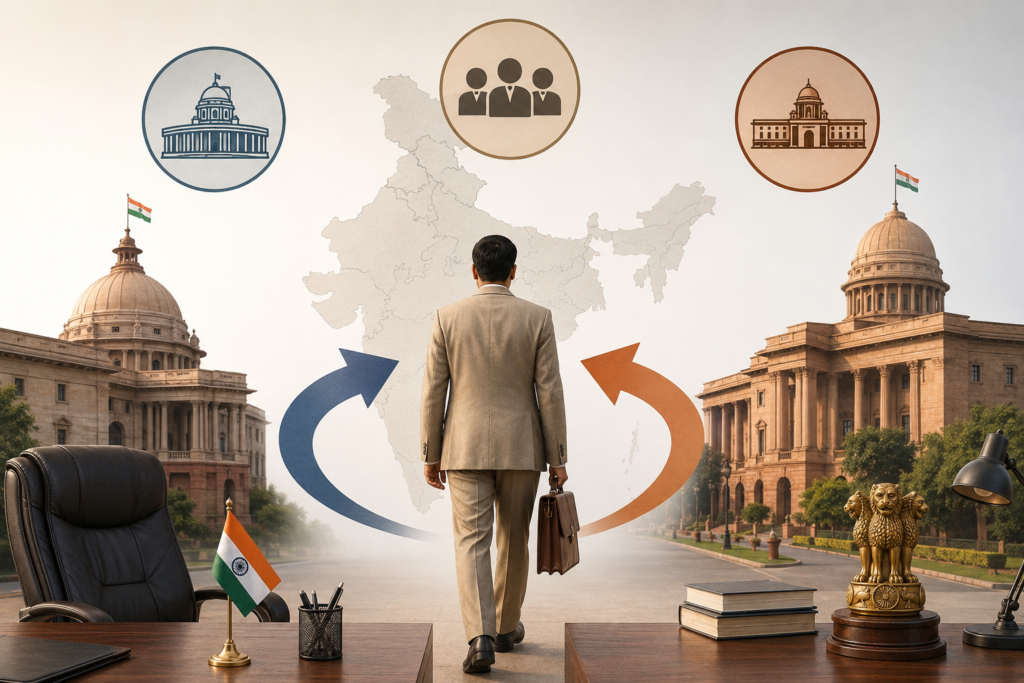

The Supreme Court of India recommended the formation of Civil Services Boards to ensure transparency in transfers and postings.
The CSB advises on:
However, the final decision is generally taken by the government.
Yes, IAS officers can be transferred multiple times during their career. However, the Supreme Court suggested a minimum fixed tenure of two years for key postings to maintain administrative efficiency and reduce political pressure.
Frequent transfers may happen due to:
IAS officers are allotted to specific state cadres after selection through the UPSC Civil Services Examination. Inter-state transfers are rare but possible under special conditions such as:
Such transfers require approval from:
The Union Public Service Commission conducts the Civil Services Examination and recruits IAS officers, but it does not handle transfers after recruitment. Transfer and posting matters are managed by the government authorities.
Transfers help:
An IAS officer may serve in rural, urban, secretariat, and policy-making roles throughout their career, gaining diverse administrative exposure.
Although transfers are necessary, excessive or politically motivated transfers can affect governance. Frequent changes in leadership may slow development projects and reduce administrative continuity.
Experts often recommend:
These measures can help improve the efficiency of the Indian administrative system.
The transfer of an IAS officer is mainly controlled by the State Government or the Central Government depending on the officer’s posting. While state governments manage transfers within the state cadre, the Central Government handles central deputation and certain high-level postings. The Civil Services Board also plays an advisory role in ensuring fair and transparent transfers.
Transfers are an essential part of an IAS officer’s career and are designed to maintain effective governance, administrative balance, and public service efficiency across the country.
© 2025 Created & Maintained by PM IAS ACADEMY – Unit of Plover Minds Institute LLP