When it comes to prestigious government jobs in India, two names dominate the conversation — the Indian Administrative Service (IAS) and the Indian Police Service (IPS). Many UPSC aspirants often ask one common question:
“Who has more power — IAS or IPS?”
The answer is not as simple as choosing one over the other. Both officers hold significant authority, but their powers, responsibilities, and areas of influence are completely different.
Let’s understand the real difference between IAS and IPS officers in detail.
An IAS officer belongs to the administrative branch of the Indian government. They are responsible for:
IAS officers usually work closely with ministers and government departments.
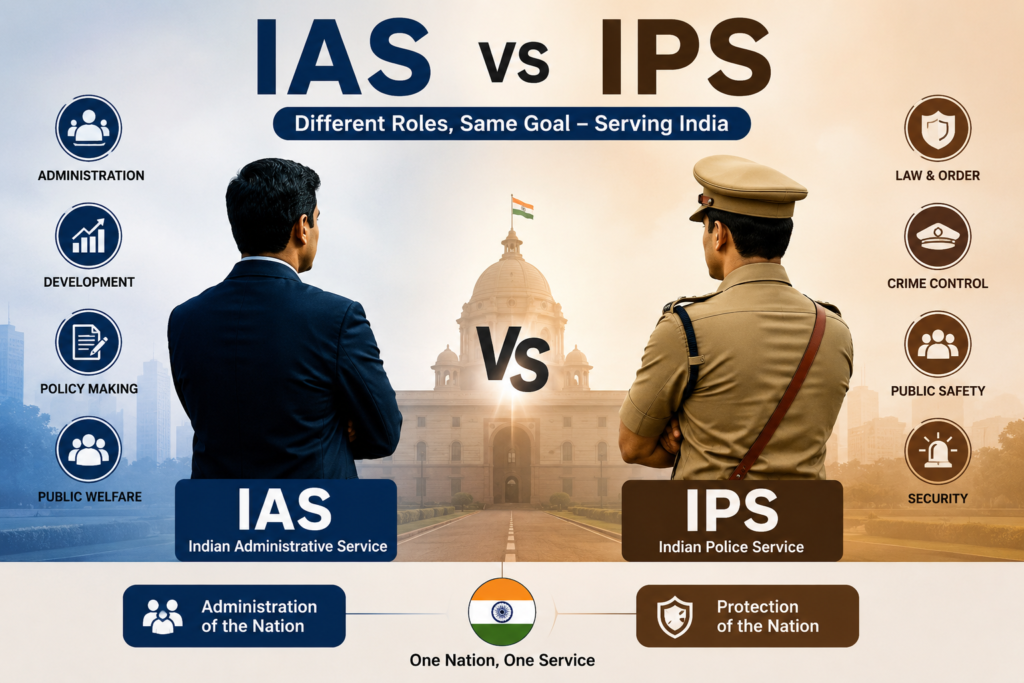

An IPS officer belongs to the police and internal security system of India. Their main responsibility is maintaining law and order.
The comparison depends on the situation because both officers control different systems.
| Factor | IAS Officer | IPS Officer |
|---|---|---|
| Administrative Authority | Higher | Limited to police administration |
| Law & Order Control | Supervises overall district administration | Direct control over police force |
| Government Decision Making | Strong involvement | Limited involvement |
| Field Power | Moderate | Very high |
| Public Influence | High | Very high |
| Policy Making | Yes | Rare |
| Salary & Benefits | Similar | Similar |
In India’s administrative structure, IAS officers are generally considered to hold more authority because:
An IAS officer often has broader administrative control over an entire district or department.
IPS officers command the police force and maintain public safety. Their field-level authority is extremely strong.
An IPS officer can:
In real-world situations involving crime or security, IPS officers often exercise immediate operational power.
Both services receive immense respect in society.
The respect depends more on the officer’s work and public service than the designation itself.
Many people think IAS and IPS officers compete with each other, but in reality, they work together.
For example:
A district functions effectively only when both services cooperate.
Choose IAS if you are interested in:
Choose IPS if you are interested in:
Technically, IAS officers hold broader administrative authority in the government structure. However, IPS officers possess strong operational and policing powers on the ground.
So the better question is not:
“Who is more powerful?”
Instead ask:
“Which role matches your passion and personality?”
Both IAS and IPS officers serve the nation with great responsibility, authority, and respect.
© 2025 Created & Maintained by PM IAS ACADEMY – Unit of Plover Minds Institute LLP