
Introduction
If you are wondering how to start UPSC preparation from scratch, you are not alone. Lakhs of graduates choose the Civil Services Examination every year, and most begin with the same questions: which books, in what order, and for how many hours a day? This guide answers them in simple steps. It covers the UPSC exam pattern, the syllabus, a 12-month plan for UPSC preparation for beginners, and the mistakes to avoid. It is prepared by PM IAS Academy, Coimbatore.
What Is the UPSC Civil Services Examination?
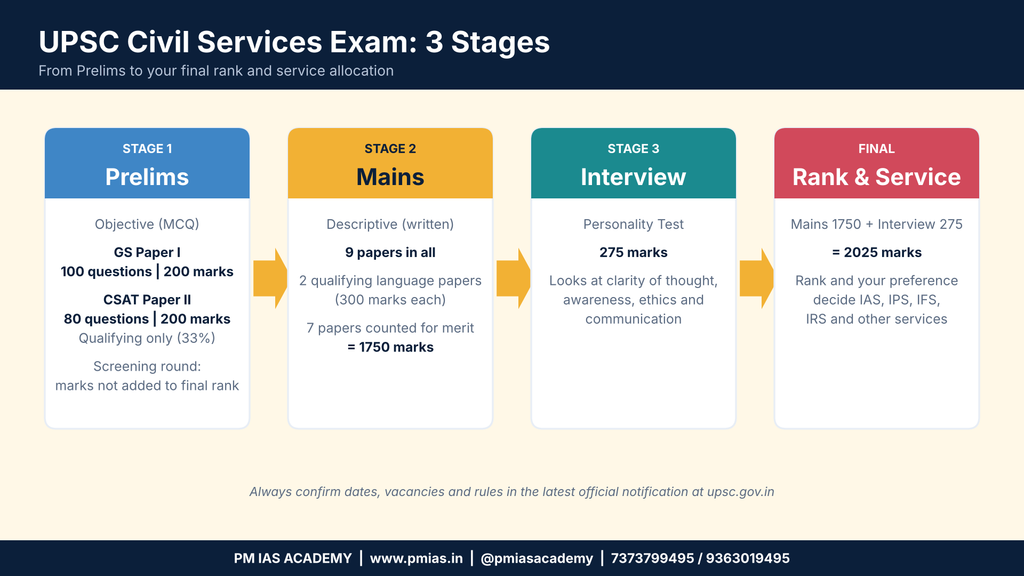
The Union Public Service Commission (UPSC) conducts the Civil Services Examination (CSE) to recruit officers for the IAS, IPS, IFS and other central services. The exam has three stages: the Preliminary examination, the Main examination and the Personality Test (Interview).
Your final rank depends only on Mains and Interview marks. Prelims is a screening round that decides whether you move on to Mains.
UPSC Exam Pattern at a Glance
The final merit list has 2025 marks: 1750 from Mains and 275 from the Interview. Prelims marks are not added.
| Stage | Paper | Type | Marks | Counts for rank? |
|---|---|---|---|---|
| Prelims | General Studies Paper I | 100 MCQs | 200 | No, used for cut-off |
| Prelims | CSAT Paper II | 80 MCQs | 200 | No, qualifying (33%) |
| Mains | Paper A: Indian language | Descriptive | 300 | No, qualifying |
| Mains | Paper B: English | Descriptive | 300 | No, qualifying |
| Mains | Essay | Descriptive | 250 | Yes |
| Mains | General Studies Papers I to IV | Descriptive | 4 x 250 = 1000 | Yes |
| Mains | Optional Papers I and II | Descriptive | 2 x 250 = 500 | Yes |
| Interview | Personality Test | Interview | 275 | Yes |
Wrong answers in Prelims carry negative marking, so accuracy matters as much as speed.
Eligibility in Brief
- Qualification: a degree in any discipline from a recognised university. Final-year students can apply if they complete the degree within the notified time.
- Age: 21 to 32 years for General candidates, up to 35 for OBC and up to 37 for SC/ST, counted as on 1 August of the exam year.
- Attempts: 6 for General and EWS, 9 for OBC, and unlimited for SC/ST within the age limit.
Rules and relaxations can change, so always confirm them in the latest official notification at upsc.gov.in.
How to Start UPSC Preparation: 7 Simple Steps
- Understand the UPSC syllabus and past papers. Download the official syllabus from upsc.gov.in and solve the last five years of Prelims papers before you buy any book. This shows you what UPSC actually asks.
- Build your base with NCERTs. Read NCERT textbooks from Class 6 to 12 for History, Geography, Polity, Economy and Science. They are simple and clear the concepts.
- Move to one standard book per subject. For example, M. Laxmikanth for Indian Polity, Spectrum for Modern History and Ramesh Singh for Indian Economy. Collecting many books only delays revision.
- Read a newspaper every day. Follow The Hindu or The Indian Express, make short notes and link each news item to a static topic. Use daily current affairs material to stay consistent.
- Choose your optional subject carefully. It carries 500 marks. Decide on interest, availability of guidance and overlap with General Studies.
- Start answer writing early. Mains is descriptive, so write at least one answer a day from the first few months, even if it is rough.
- Test and revise. Join a Prelims test series, analyse every mistake and revise in cycles.
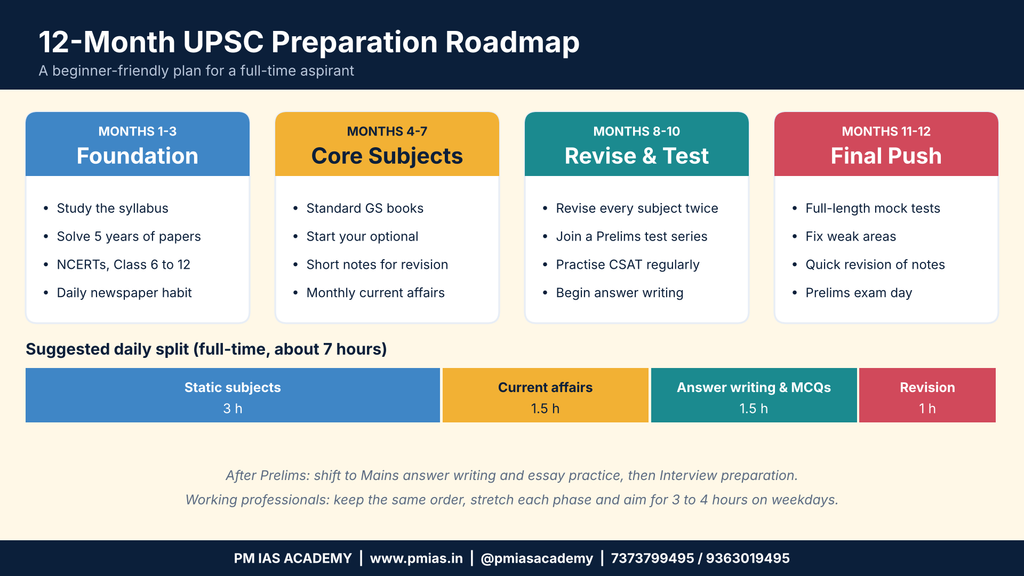
12-Month UPSC Preparation Plan
This roadmap suits a full-time aspirant. Working professionals can follow the same order and stretch each phase over more months.
Revision and mock tests turn reading into marks, so do not skip the last two phases. CSAT is only qualifying, but you need 33% to pass it, so practise it every week.
Understanding the UPSC Mains Papers
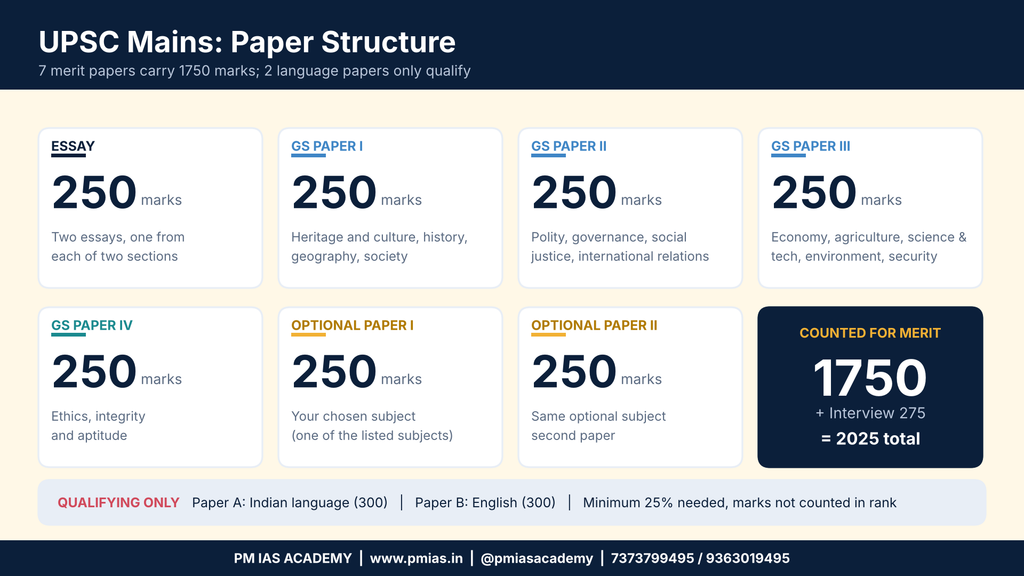
Mains tests how well you can write, not only what you know. The four General Studies papers cover these areas:
- GS Paper I: Indian heritage and culture, history, geography and society.
- GS Paper II: governance, Constitution, polity, social justice and international relations.
- GS Paper III: technology, economic development, biodiversity, environment, security and disaster management.
- GS Paper IV: ethics, integrity and aptitude.
Practise in the real format: about 150 words for a 10-mark question and 250 words for a 15-mark question, written within the time limit.
Common Mistakes Beginners Make
- Buying too many books and revising none of them.
- Reading without writing. Mains marks come from answer writing, so starting late costs you.
- Leaving CSAT for the last month.
- Studying current affairs in bursts instead of daily.
- Changing strategy every few weeks after comparing yourself with other aspirants.
- Avoiding mock tests for fear of a low score. Early low scores show you what to fix.
Do You Need Coaching? UPSC Coaching in Coimbatore
Self-study can work if you are highly disciplined, but many beginners find it hard to build a schedule, get feedback and stay consistent alone. Good coaching gives you a plan, mentoring, regular tests and a peer group. It does not replace your own effort.
When you compare UPSC coaching in Coimbatore, check these points:
- Is the syllabus covered in a clear schedule that joins Prelims and Mains preparation?
- Are tests held regularly, with answer evaluation and feedback?
- Do you get personal mentoring and doubt clearing?
- Is current affairs updated every day?
- Is there a place to study, such as a study hall?
PM IAS Academy in Coimbatore offers UPSC, TNPSC and Banking coaching, the NIRMAN Prelims Test Series, current affairs material and a study hall.
Know more about the test series click here.
Frequently Asked Questions
Can I start UPSC preparation from scratch?
Yes. You need a graduation degree, not prior knowledge. Start with the syllabus and NCERTs, then follow a fixed plan.
How many hours should I study every day?
Full-time aspirants often study 6 to 8 hours. Working professionals can begin with 3 to 4 hours on weekdays and study more on weekends.
How long does UPSC preparation take?
Most focused beginners plan for 12 to 18 months before their first attempt. The time depends on your base, your daily hours and your consistency.
Which optional subject is best?
There is no single best optional. Choose one you understand and enjoy, with reliable guidance and some overlap with General Studies.
Is coaching necessary for UPSC?
No, but it helps with structure, tests and mentoring, especially for beginners.
Is there good UPSC coaching in Coimbatore?
PM IAS Academy offers UPSC coaching in Coimbatore with a Prelims test series and current affairs support. Call 7373799495 or 9363019495, or visit www.pmias.in.
Start Your UPSC Journey Today
UPSC preparation for beginners is a long journey, but a clear plan makes it manageable. Study the syllabus, build your base, write answers daily and revise often. For guidance, mentoring and test practice in Coimbatore, speak to the PM IAS Academy team.
Call 7373799495 / 9363019495 | www.pmias.in | Instagram @pmiasacademy